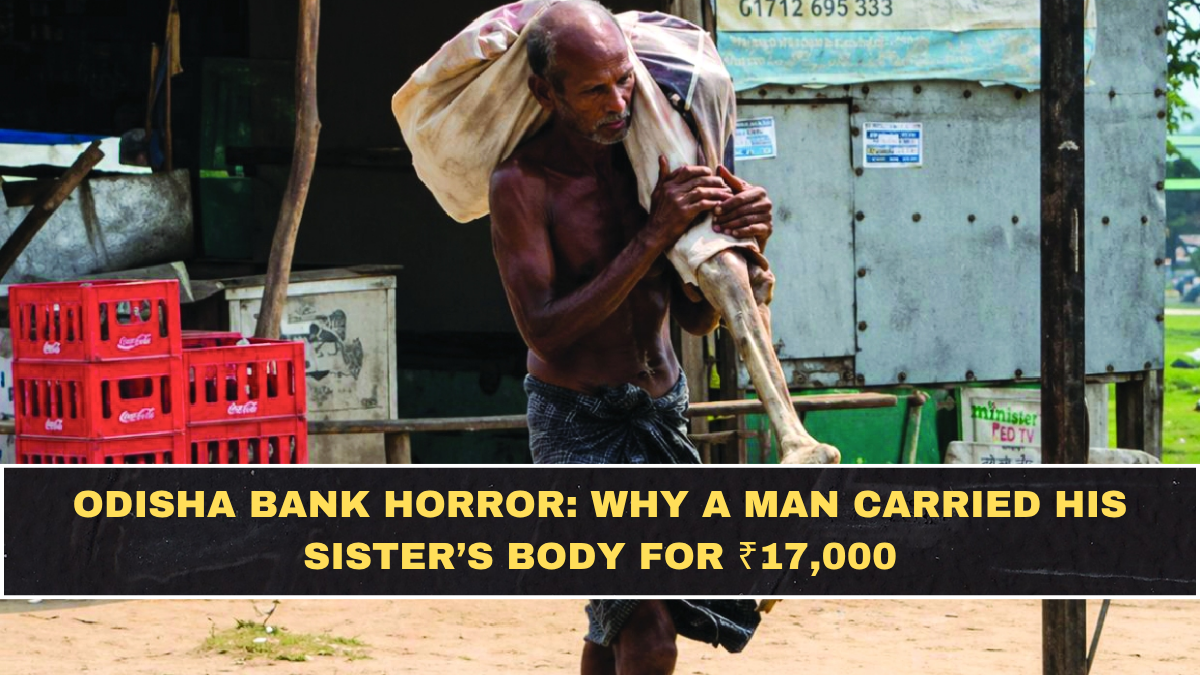
A deeply disturbing case from Keonjhar district in Odisha has gone viral after a man reportedly carried the exhumed remains of his deceased sister to a bank to prove her death and claim money from her account. The man, identified in reports as Jitu Munda, said he had been struggling to access the money because he did not have the required death certificate.
The incident happened at an Indian Overseas Bank branch and triggered outrage after videos and reports spread online. The Guardian reported that Munda’s sister, Kalara, had left around ₹19,300 in her account after selling livestock before her death several months earlier. After the incident became public, authorities reportedly issued the death certificate and released the money to the family.
Why Did He Carry His Sister’s Remains To The Bank?
According to reports, Jitu Munda claimed he was repeatedly unable to withdraw his sister’s money because he could not produce official proof of her death. In desperation, he allegedly exhumed her remains and took them to the bank as physical proof that she had died. It is a horrifying image, but it also exposes how badly bureaucracy can fail people who are poor, marginalised or unaware of formal procedures.
Times of India reported that the man eventually received ₹19,402 after local authorities intervened and issued the required death certificate and legal heir certificate. The amount was small by urban middle-class standards, but for a poor tribal family, even ₹17,000–₹19,000 can matter deeply. That is exactly why this case has angered so many people.
| Key Detail | Reported Information |
|---|---|
| Location | Keonjhar district, Odisha |
| Man involved | Jitu Munda |
| Deceased person | His sister, Kalara |
| Bank involved | Indian Overseas Bank branch |
| Claimed issue | Lack of death certificate/legal proof |
| Amount involved | Around ₹19,300–₹19,402 reported |
| Official response | Certificates issued and money released |
| Bigger concern | Bureaucracy, poverty and access to banking rights |
Was The Bank Directly At Fault?
This is where the story becomes complicated. The bank reportedly said it had only asked for legal documents and had not asked the man to bring physical remains. In normal banking procedure, that position is not unreasonable. Banks cannot release money from a deceased person’s account just because someone verbally claims to be a relative. They need proof to prevent fraud, disputes and wrongful withdrawal.
But hiding behind procedure is not enough either. India Today reported that a preliminary Odisha government probe found bank staff may not have cooperated properly with the man and pointed to possible procedural lapses. If a poor and vulnerable claimant does not understand the process, the humane response is to guide him clearly, not let the matter become so desperate that he brings a skeleton to the branch.
Why Did This Case Spark Political Uproar?
The case became a political issue because it looked like a complete failure of dignity, welfare delivery and administrative support. NDTV reported that the incident sparked uproar in the Odisha Assembly, with Congress MLAs protesting and briefly walking out during a special session. Opposition leaders also criticised the state government over alleged insensitivity and governance failures.
This is not surprising. A man carrying his sister’s remains to a bank is not just a viral incident. It is a symbolic failure. It shows how people at the bottom of the system can be crushed between paperwork, bank rules, local administration delays and lack of awareness. Politicians will naturally use it, but the core issue is real.
What Documents Are Usually Needed After A Bank Account Holder Dies?
When a bank account holder dies, banks usually require documents such as a death certificate, identity proof of the claimant, legal heir certificate or succession-related documents depending on the account type, nominee status and amount involved. If the deceased had a registered nominee, the process can be easier. If there is no nominee, the bank may ask for additional proof.
The problem is not that documents are required. The problem is that poor families often do not know which document to get, where to get it, how long it will take or who can help them. That gap creates suffering. Procedures protect banks from fraud, but they also need human support systems so legitimate families are not trapped.
Why Is This Case Bigger Than One Bank Branch?
This case is bigger because it exposes a wider problem in India’s welfare and banking system. Millions of people have bank accounts because of financial inclusion drives, but not everyone has equal ability to navigate documentation, claims, nominee updates or death-related formalities. Having a bank account is not the same as having real access to banking justice.
For poor tribal families, daily survival already includes barriers such as distance, language, lack of paperwork, weak digital access and fear of officials. When such a person is asked for documents without proper guidance, the system may technically be correct but morally useless. That is the uncomfortable truth this case exposes.
What Should Banks Learn From This Incident?
Banks need to train branch staff to handle death claims involving vulnerable families with more clarity and compassion. Staff should provide a written checklist in the local language, explain the process step by step, guide claimants toward the correct authority and escalate hardship cases quickly. A bank cannot just say “bring documents” and send people away repeatedly.
At the same time, banks must protect accounts from fraud. That part is valid. But fraud prevention and humane assistance are not opposites. A good system can verify documents while still helping poor families get those documents. If a claimant is illiterate, tribal, elderly or distressed, the branch must treat that as a support need, not an inconvenience.
What Should Families Do To Avoid Such Problems?
Families should ensure every bank account has an updated nominee. This is one of the simplest ways to reduce trouble after death. Account holders should also keep Aadhaar, mobile number, address and family details updated with the bank. If an elderly or vulnerable person has money in an account, the family should know the branch, account details and nominee status.
People avoid these discussions because death is uncomfortable. That avoidance is stupid. A nominee update takes far less effort than a legal battle after someone dies. If families want to protect their money and dignity, they must handle basic financial paperwork while everyone is alive.
What Should The Government Do Now?
The government should not treat this case as solved only because the family received the money. That would be lazy damage control. There should be a proper investigation into whether the bank, local administration or certificate-issuing authorities delayed help. If mistakes happened, accountability should follow.
More importantly, Odisha and other states need better support at the village and panchayat level for death certificates, legal heir documents and bank claim assistance. Poor families should not have to understand the banking system alone. Local officials should help them complete formalities before desperation turns into public tragedy.
Conclusion?
The Odisha bank dead body case is horrifying because it shows a man reaching an extreme point just to claim his deceased sister’s small savings. Reports say the family eventually received around ₹19,402 after authorities intervened, but the damage to dignity had already happened.
The blunt truth is that this was not only a banking issue. It was a human failure across procedure, communication and support. Documents are necessary, but a system that cannot guide a poor man before he carries skeletal remains to a bank has no right to call itself efficient. This case should lead to better branch training, faster certificates and stronger help for vulnerable families.
FAQs
What Happened In The Odisha Bank Case?
A man in Keonjhar district reportedly carried the exhumed remains of his deceased sister to a bank to prove her death and claim money from her account. The incident went viral and led to public outrage over banking procedure and administrative failure.
How Much Money Was In The Sister’s Bank Account?
Reports gave the amount as around ₹19,300 to ₹19,402. The money was reportedly released to the family after local authorities intervened and issued the required death certificate and legal heir certificate.
Did The Bank Ask Him To Bring The Body?
The bank reportedly denied asking him to bring physical remains and said it only requested proper legal documentation. However, a preliminary probe reportedly found that bank staff may not have cooperated properly with the man.
What Documents Are Needed To Claim A Dead Person’s Bank Money?
Usually, banks ask for a death certificate, claimant identity proof, nominee details or legal heir certificate depending on the account and case. If there is no nominee, the process may require additional legal documents before the money is released.