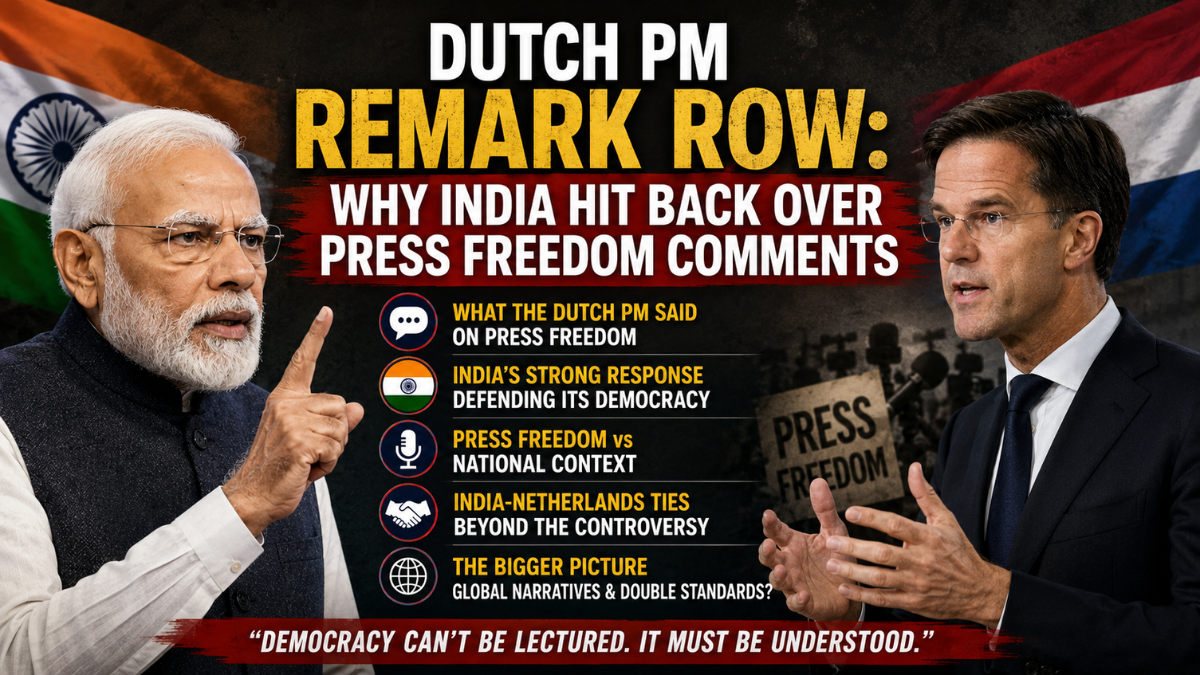
The Dutch PM press freedom remark row became a diplomatic talking point during Prime Minister Narendra Modi’s Netherlands visit, after reported concerns were raised around press freedom and minority rights in India. New Delhi pushed back strongly, with Ministry of External Affairs Secretary West Sibi George saying such questions showed a “lack of understanding” of India’s democracy, diversity and constitutional values.
The timing made the exchange sharper because India and the Netherlands were also celebrating upgraded ties during the same visit. Instead of only trade and strategic partnership making headlines, the media-freedom and minority-rights question created a visible diplomatic friction point. That is why this story matters beyond one press-room exchange.
What Did India Say?
India rejected the idea that media freedom or minority rights are declining in the country. The MEA official defended India as a vibrant democracy and highlighted its pluralism, civilisational history and constitutional framework. The response came after a Dutch journalist raised questions about the absence of a joint press interaction and concerns around rights in India.
| Issue Raised | India’s Response |
|---|---|
| Press freedom | India rejected the criticism |
| Minority rights | MEA defended India’s pluralism |
| Joint press interaction | Question came during media exchange |
| Diplomatic setting | PM Modi’s Netherlands visit |
| Bigger context | Strategic partnership announced |
The blunt point is this: India did not give a soft answer. It directly framed the criticism as uninformed and pushed back using democracy, diversity and constitutional protection as its core argument. That tone shows New Delhi is increasingly unwilling to let Western rights criticism pass without a public counter.
Why Did This Become Sensitive?
The issue became sensitive because press freedom and minority rights are not ordinary diplomatic topics. They touch national image, domestic politics, international perception and democratic credibility. When a foreign leader or foreign media raises such concerns during a prime ministerial visit, the host-country narrative can quickly shift from cooperation to criticism.
This is also where India’s response must be understood carefully. New Delhi is trying to protect its global image while also expanding relations with Europe. If it ignores criticism, the narrative may harden internationally. If it responds too aggressively, it can look defensive. That balance is difficult, and this exchange showed exactly that tension.
What Was Happening In Ties?
At the same time, India-Netherlands relations were moving forward. During PM Modi’s May 16–17, 2026 visit to the Netherlands, both sides elevated ties to a strategic partnership and issued a joint statement covering cooperation across trade, technology, water, agriculture, defence, innovation and global challenges.
This is why the row should not be read as a breakdown in ties. It is more accurate to call it a sharp disagreement inside a growing partnership. Countries can cooperate on trade and technology while disagreeing publicly on rights and democratic issues. That is normal diplomacy, not necessarily a crisis.
Why Netherlands Matters?
The Netherlands is an important European partner for India, especially in water management, agriculture, ports, technology and trade. During the visit, the two countries also discussed cooperation in areas such as innovation, semiconductors, digital technology, clean energy and climate action.
Key areas to watch now:
- Strategic partnership implementation
- Trade and investment follow-up
- Water and infrastructure cooperation
- Technology and semiconductor collaboration
- Whether rights criticism appears in future EU talks
- How both sides manage public disagreements
The honest reality is that Europe will continue raising democracy and rights questions with India. India will continue rejecting what it sees as selective or poorly informed criticism. The relationship will depend on whether both sides can keep cooperation moving despite these uncomfortable exchanges.
What Is The Real Message?
The real message is that India wants to be treated as a major democratic power, not as a country that accepts lectures silently. At the same time, global scrutiny on press freedom and minority rights is not going away. India’s challenge is to answer criticism with confidence, but also with openness where legitimate questions exist.
For readers, the smart way to understand this row is not to reduce it to nationalism versus criticism. The issue is diplomatic messaging. India is asserting sovereignty and democratic credibility, while European actors continue to frame rights as part of foreign-policy dialogue. Both are playing to domestic and international audiences.
Conclusion?
The Dutch PM remark row became important because it collided with a major India-Netherlands diplomatic visit. India strongly rejected reported concerns around press freedom and minority rights, calling them rooted in a lack of understanding, even as both countries elevated ties to a strategic partnership.
The blunt takeaway is simple: this is not a collapse in relations, but it is a warning sign. India-Europe ties are growing, but human-rights and democracy questions will keep appearing. If both sides want the partnership to mature, they must handle disagreement without letting it derail trade, technology and strategic cooperation.
FAQs?
What Is Dutch PM Press Freedom Remark Row?
It refers to the diplomatic exchange during PM Modi’s Netherlands visit after reported concerns were raised around press freedom and minority rights in India. New Delhi rejected the criticism strongly through an MEA official response.
What Did India Say In Response?
India said such criticism reflected a lack of understanding of the country’s democracy, diversity and constitutional values. The MEA official defended India as a vibrant democracy with strong pluralism.
Did This Affect India-Netherlands Relations?
It created a diplomatic talking point, but it did not stop both countries from upgrading ties to a strategic partnership. The broader relationship still focuses on trade, technology, water, agriculture and global cooperation.
Why Is This Issue Important?
The issue matters because press freedom and minority rights affect India’s global democratic image. It also shows how India and European partners may cooperate strategically while disagreeing publicly on sensitive political questions.