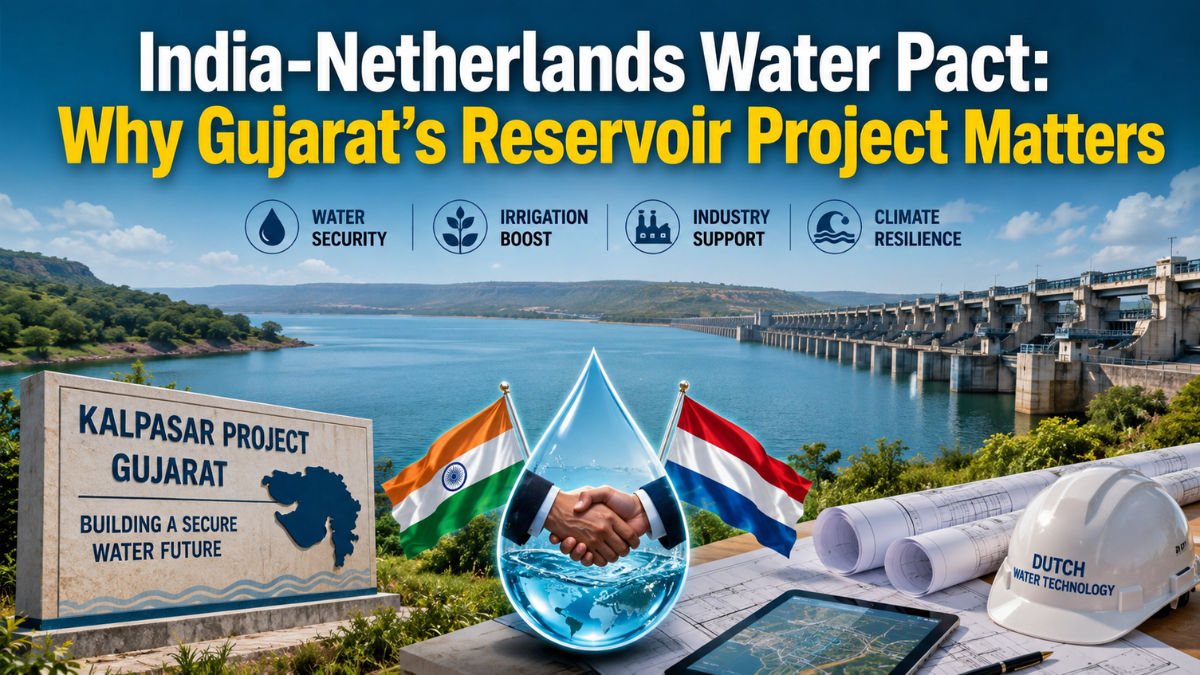
Gujarat’s freshwater reservoir plan is back in focus after India and the Netherlands signed a Letter of Intent for technical cooperation on the Kalpasar Project. The project aims to create a large freshwater reservoir across the Gulf of Khambhat, while also integrating tidal power generation, irrigation and transportation infrastructure.
This is not a normal water project. It is one of those huge infrastructure ideas that can either become a long-term water-security breakthrough or a costly engineering headache if handled badly. Gujarat needs water security, but a coastal reservoir of this scale demands serious science, not political excitement alone.
What Is Kalpasar Project?
Kalpasar is Gujarat’s ambitious plan to build a freshwater reservoir in the Gulf of Khambhat by separating seawater from river inflows through a large dam-like structure. Deccan Herald reported that the project is planned as a 13,000 million cubic metre freshwater reservoir, making it a massive water-storage idea for the state.
| Project Detail | Current Update |
|---|---|
| Project Name | Kalpasar Project |
| Location | Gulf of Khambhat, Gujarat |
| Main Aim | Freshwater reservoir creation |
| Added Goals | Irrigation, tidal power and transport |
| Dutch Role | Technical cooperation and water expertise |
| Core Risk | Cost, ecology, salinity and execution |
The project has been discussed for decades, but the new Dutch cooperation has made it relevant again. Times of India reported earlier that the DPR was in its final stage and the project may take around eight years after approvals, showing that this is still a long-term execution challenge, not an instant solution.
Why Dutch Tech Matters?
The Netherlands is globally known for water management, sea barriers, flood control and coastal engineering. Prime Minister Narendra Modi visited the Afsluitdijk Dam in the Netherlands with Dutch Prime Minister Rob Jetten, and the visit highlighted parallels with Gujarat’s Kalpasar Project.
Dutch expertise matters because Gujarat’s challenge is not just storing water. The real challenge is managing seawater, freshwater inflow, tides, silt, flooding, salinity and long-term maintenance. If Dutch experience can help India avoid design mistakes, the partnership may save money, time and environmental damage later.
What Can Gujarat Gain?
If executed properly, the Gujarat freshwater reservoir can support drinking water supply, irrigation and industrial growth. The project can also improve climate resilience because water stress is becoming a bigger concern for cities, farms and industries. A large reservoir may help Gujarat store freshwater during surplus flow periods and use it during dry months.
Possible benefits include:
- Better water storage for drought-prone periods
- Irrigation support for agriculture
- Drinking water supply for growing cities
- Industrial water availability
- Possible tidal power generation
- Better connectivity through transport infrastructure
But let’s not pretend this is guaranteed. Large projects often look beautiful in presentations and become messy during land, environmental and financial execution. Gujarat should demand transparent feasibility studies, updated cost estimates and strict ecological review before treating Kalpasar as a miracle answer.
What Are The Biggest Risks?
The biggest risks are ecological disturbance, salinity control, siltation, cost escalation, rehabilitation concerns and long approval delays. The Gulf of Khambhat is a complex coastal zone, and any major barrier across it can affect tidal movement, marine life, sediment flow and coastal livelihoods if not studied properly.
This is where blind development talk becomes dangerous. A freshwater reservoir near the sea sounds attractive, but if salinity seeps in or siltation becomes uncontrollable, the project’s value can decline sharply. Gujarat needs expert review, independent scrutiny and public transparency, not just big claims about water security.
Why Is This Nationally Important?
India’s water stress is not limited to Gujarat. Many states are facing pressure from erratic rainfall, groundwater depletion, urban growth and climate-related flooding. That is why a successful Gujarat freshwater reservoir model could influence future coastal water projects in other parts of the country.
The India-Netherlands cooperation is also part of a wider water-management relationship. The official visit documents mention a Letter of Intent between India’s Ministry of Jal Shakti and the Netherlands’ Ministry of Infrastructure and Water Management, showing that water has become a serious diplomatic and infrastructure priority.
Conclusion?
Gujarat’s freshwater reservoir project can become one of India’s most important water-security stories if it is planned with technical depth and environmental honesty. The Kalpasar Project aims to create a major reservoir across the Gulf of Khambhat, with Dutch water-management expertise now adding fresh momentum to the discussion.
The blunt truth is simple: Dutch technology can help, but it cannot rescue poor planning. If Gujarat handles cost, ecology, salinity, siltation and execution seriously, Kalpasar may become a landmark project. If it becomes only a political trophy, it could turn into an expensive warning.
FAQs
What Is Gujarat Freshwater Reservoir Project?
Gujarat freshwater reservoir project refers mainly to the Kalpasar Project, which aims to create a large freshwater reservoir across the Gulf of Khambhat. It is expected to support water storage, irrigation, transport and possibly tidal power generation.
Why Is The Netherlands Involved?
The Netherlands is involved because it has strong expertise in coastal water management, sea barriers, flood control and climate-resilient infrastructure. India and the Netherlands have signed a Letter of Intent for technical cooperation on Kalpasar.
Can Kalpasar Solve Gujarat’s Water Problem?
Kalpasar can help Gujarat’s water security if it is designed and executed properly. However, it cannot be treated as a magic solution because ecological, financial, salinity and engineering risks remain serious.
When Will The Project Be Completed?
There is no immediate completion date. Earlier reporting said the DPR was in its final stage and the project could take around eight years after necessary approvals. Citizens should wait for official timelines before assuming fast execution.