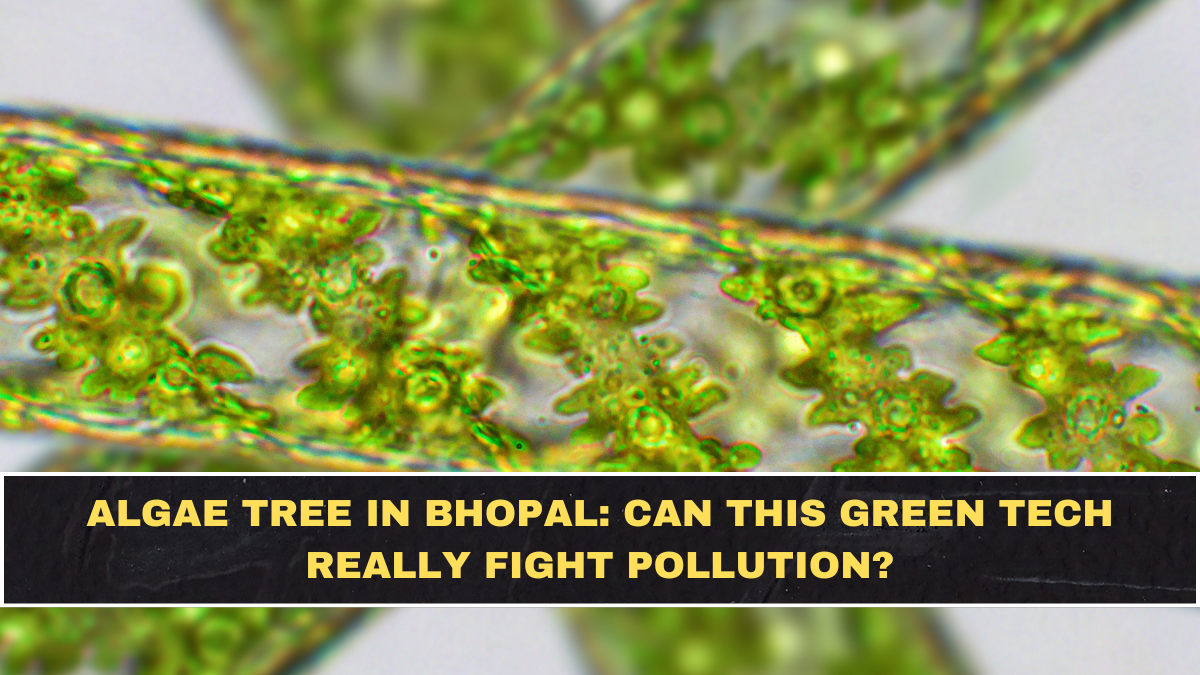
Bhopal’s new “Algae Tree” has gone viral because it looks like the kind of futuristic clean-air technology Indian cities keep talking about but rarely test in public spaces. Reports say the machine has been installed at Ashoka Garden’s Swami Vivekananda Park and uses microalgae to absorb carbon dioxide and release oxygen. It is being described as India’s first public algae-tree installation of this type.
The hype is understandable, but people need to stay realistic. One machine cannot clean an entire city’s air, and anyone selling it as a replacement for real trees is exaggerating. Still, as a demonstration of bio-based pollution-control technology, the Bhopal algae tree is interesting because it shows how cities may combine nature and engineering for cleaner public spaces.
How Does This Algae Tree Work?
The algae tree is not a normal tree. It is a machine that uses microalgae, tiny photosynthetic organisms, to capture carbon dioxide and release oxygen. Reports say the Bhopal installation needs water and electricity to function and can filter around 2,000 litres of air in an hour. It is also being claimed that one unit can work like nearly 25 trees in terms of oxygen-related output.
The science behind the idea is not imaginary. Research on microalgae-based “liquid tree” systems says microalgae can capture carbon dioxide through photosynthesis and release oxygen as a by-product. That makes algae-based air-cleaning systems attractive for dense urban areas where land for large green cover is limited.
| Feature | What It Means |
|---|---|
| Location | Swami Vivekananda Park, Ashoka Garden, Bhopal |
| Core technology | Microalgae-based carbon capture |
| Claimed output | Around 25 trees’ oxygen-related work |
| Air filtration claim | Around 2,000 litres per hour |
| Basic needs | Water and electricity |
| Best use case | Demonstration, awareness and local air-support zones |
Why Is Bhopal Getting Attention?
Bhopal is getting attention because this is not just a lab experiment hidden inside a research centre. It is installed in a public park, where ordinary citizens can see what clean-air technology looks like. That visibility matters because environmental ideas often remain trapped in conferences while cities keep breathing polluted air.
The project is also being linked to student innovation, with reports saying it was developed by students of MP Women’s Polytechnic College. That part deserves credit because cities need local innovation, not only imported solutions. But credit should not become blind worship; the technology must be tested, maintained and measured honestly before bigger claims are made.
Can It Really Fight Pollution?
Yes, but only in a limited way. An algae tree can help with localised carbon capture and awareness, but it cannot solve the larger pollution problem caused by vehicles, construction dust, road dust, industry, garbage burning and poor urban planning. The dangerous mistake would be using such machines as a publicity shortcut while ignoring the real pollution sources.
WHO says ambient air pollution is a major health risk, with outdoor air pollution estimated to have caused 4.2 million premature deaths worldwide in 2019. Fine particulate pollution is linked to serious health issues such as heart disease, stroke, lung cancer and respiratory diseases. That scale of risk cannot be solved by a few machines in parks.
Why Are Real Trees Still Better?
Real trees do more than produce oxygen or absorb carbon dioxide. They reduce heat, support biodiversity, improve soil, provide shade, reduce noise, hold water, protect birds and make neighbourhoods more livable. An algae tree may support clean-air innovation, but it cannot replace an urban forest.
This is the blunt truth: if a city cuts real trees and then installs artificial algae trees for publicity, that is not progress. It is environmental theatre. Bhopal itself has faced concern over green-cover loss, with the National Green Tribunal seeking a status report on alleged tree-cover damage and asking for reforestation planning.
Where Can Algae Trees Help?
Algae trees may be useful in specific spots where planting large trees is difficult or where public awareness is needed. Traffic junctions, dense commercial zones, parks, campuses and high-footfall public areas could be possible locations if maintenance is practical. They may also help schools and colleges teach climate and air-quality science in a visible way.
Useful applications may include:
- Public parks with environmental education displays
- Traffic-heavy zones with limited plantation space
- Smart-city demonstration projects
- College and school climate-tech projects
- Indoor or semi-outdoor air-quality experiments
- Localised carbon-capture awareness installations
What Are The Challenges?
The biggest challenge is maintenance. Algae systems need controlled conditions, regular cleaning, water quality, electricity, monitoring and technical support. If the algae culture dies, the machine becomes a dead display item. Cities are full of smart projects that looked impressive at launch and then quietly stopped working because nobody maintained them.
Another problem is measurement. Authorities should publish performance data: how much carbon dioxide is captured, how much oxygen is released, how often the unit needs servicing and what the operating cost is. Without transparent numbers, the algae tree remains a viral claim, not a proven urban solution.
Conclusion?
Bhopal’s algae tree is an exciting clean-tech experiment because it brings microalgae-based carbon capture into a public space. It can raise awareness, support local innovation and show that urban pollution solutions can combine biology with technology. That is worth attention.
But let’s not fool ourselves. Algae trees are not a substitute for reducing emissions, controlling dust, improving public transport or protecting real green cover. The right approach is to treat this as one small tool in a much larger clean-air strategy. Green tech is useful, but only when it supports real environmental action instead of replacing it.
FAQs?
What Is The Algae Tree In Bhopal?
The algae tree in Bhopal is a microalgae-based clean-air machine installed at Swami Vivekananda Park in Ashoka Garden. It uses algae to absorb carbon dioxide and release oxygen, and reports describe it as India’s first public algae-tree installation of this kind.
Can An Algae Tree Replace Real Trees?
No, an algae tree cannot replace real trees. Real trees provide shade, cooling, biodiversity, soil support and wider ecological benefits that a machine cannot fully provide. Algae trees can support local clean-air efforts, but they should not become an excuse to cut greenery.
How Much Air Can The Bhopal Algae Tree Filter?
Reports say the Bhopal algae tree can filter around 2,000 litres of air per hour and is claimed to provide oxygen-related output similar to nearly 25 trees. These claims should be tracked through transparent performance data over time.
Is Algae-Based Clean-Air Technology Scientifically Valid?
Yes, the basic science is valid because microalgae can capture carbon dioxide through photosynthesis and release oxygen. Research on microalgae-based liquid-tree systems describes them as an innovative approach for urban air-pollution and carbon-capture applications.