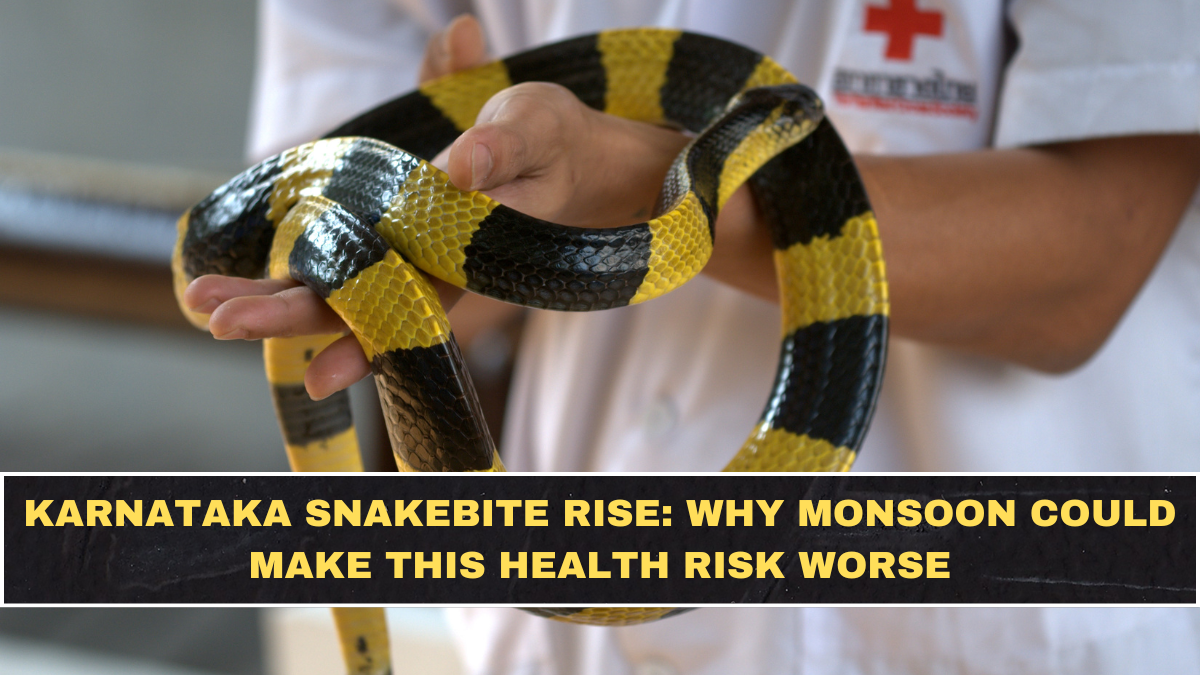
Karnataka is facing a worrying rise in snakebite cases just before the monsoon season, when human-snake encounters usually increase. Reports say the state recorded 3,939 snakebites and 39 deaths between January and April 2026, almost double the number from the same period last year. April alone reportedly saw 961 bites and 11 deaths, which makes the trend difficult to ignore.
This is not just a wildlife issue; it is a public-health problem. Snakebites hit rural families, farmers, labourers, children, and people living near forest edges or fields the hardest. If treatment is delayed because of distance, fear, myths, or lack of awareness, a survivable bite can quickly become fatal.
How Serious Are The Numbers?
| Karnataka Snakebite Data | Reported Figure |
|---|---|
| Snakebite cases from Jan-April 2026 | 3,939 |
| Deaths from Jan-April 2026 | 39 |
| April 2026 cases | 961 |
| April 2026 deaths | 11 |
| 2025 snakebite cases | Over 20,000 |
| 2025 deaths | 157 |
Karnataka had already reported more than 20,000 snakebite cases and 157 deaths in 2025, according to reports linked to the state’s action plan. Another report said Karnataka emerged as the state with the highest snakebite deaths in the country in both 2024 and 2025, with 277 deaths over three years.
The numbers may also look higher now because snakebite was classified as a notifiable disease in Karnataka in February 2024. That means reporting has improved, and more cases are being officially recorded. But improved reporting should not be used as an excuse to downplay deaths, because every delay in treatment can still cost a life.
Why Does Monsoon Make Snakebites Worse?
Monsoon increases the risk because snakes move out of flooded burrows, fields become active with farming, and people spend more time working in wet vegetation. Farmers, plantation workers, forest communities, and rural households face higher exposure during this period. Heat, changing rainfall patterns, urban expansion, and habitat disturbance are also increasing human-snake encounters.
The danger is not only in forests or villages. Expanding cities and semi-urban layouts also create snakebite risk when construction, garbage, rodents, drains, and shrinking habitats bring snakes closer to people. This is why Karnataka’s snakebite problem cannot be treated as a remote rural issue only.
Why Are Deaths Still Happening?
Deaths happen because many victims lose precious time before reaching proper medical care. Some families still try traditional healers, herbal pastes, cutting the wound, tying tight bands, or sucking out venom. These methods do not treat venom and can waste the most critical treatment window.
Major risk factors include:
- Delay in reaching hospitals with anti-venom.
- Lack of awareness about correct first aid.
- Reliance on traditional healers or home remedies.
- Poor transport access in rural and forest areas.
- Confusion in identifying venomous and non-venomous bites.
- Panic and wrong movement after the bite.
The blunt truth is that myths are killing people. Anti-venom and medical monitoring are the real treatment for venomous bites, not rituals, cuts, powders, or social media advice. If Karnataka wants fewer deaths, awareness has to reach villages before the monsoon peak, not after the tragedy.
What Should People Do After A Snakebite?
The state health department has issued basic first-aid guidance: stay calm, keep the bitten limb still, remove rings or tight items, and seek urgent medical care. People should not cut the wound, suck venom, apply ice, use herbal remedies, or tie tight tourniquets. These wrong steps can worsen injury or delay treatment.
The safest action is simple: treat every snakebite as a medical emergency. Do not wait to see whether symptoms become serious. Reach the nearest hospital or health centre quickly, because doctors can monitor symptoms, manage complications, and decide whether anti-venom is needed.
What Is Karnataka Doing Now?
Karnataka became the first Indian state to launch a comprehensive State Action Plan for the Prevention and Control of Snakebite Envenoming. The plan goes beyond only the “big four” snakes and recognises additional medically significant species. It also proposes stronger surveillance, research, community awareness, and free treatment through the Ayushman Bharat-Arogya Karnataka scheme.
Awareness campaigns are also being expanded. The Karnataka Ecotourism Development Board launched a community-driven campaign targeting schools, farmers, forest communities, and gram panchayats. The campaign specifically aims to remove harmful first-aid myths and teach people to seek immediate medical care.
Conclusion: Why Karnataka Cannot Wait?
Karnataka’s rise in snakebite cases is a serious warning before peak monsoon. The state has already seen thousands of bites and dozens of deaths in early 2026, after reporting more than 20,000 cases in 2025. Better reporting may explain part of the rise, but it does not reduce the urgency.
The real fight is not only against snakes; it is against delay, myths, poor awareness, and weak access to fast treatment. If rural communities, hospitals, schools, and local authorities act early, many deaths can be prevented. If people continue trusting old remedies over medical care, the monsoon may make this health crisis worse.
FAQs?
How many snakebite deaths has Karnataka reported in 2026?
Karnataka reportedly recorded 39 snakebite deaths between January and April 2026. During the same period, the state saw 3,939 snakebite cases, with April alone reporting 961 bites and 11 deaths. These numbers have raised concern before the monsoon season.
Why do snakebite cases rise during monsoon?
Snakebite cases rise during monsoon because snakes move out of flooded areas and people spend more time in farms, fields, and wet vegetation. Agricultural work, habitat disturbance, and poor visibility increase the chance of accidental encounters. Rural and semi-urban communities are especially vulnerable.
What should you do immediately after a snakebite?
Stay calm, keep the bitten limb still, remove tight items like rings or bangles, and reach a hospital as quickly as possible. Do not cut the wound, suck venom, apply herbal remedies, or tie a tight tourniquet. These actions can waste time and make the injury worse.
Is anti-venom available in Karnataka?
Authorities have said anti-venom availability and reporting systems have improved, but activists still point to gaps in awareness and timely access. Karnataka’s action plan aims to improve treatment, surveillance, and public education. The biggest practical challenge is making sure victims reach proper medical care quickly.