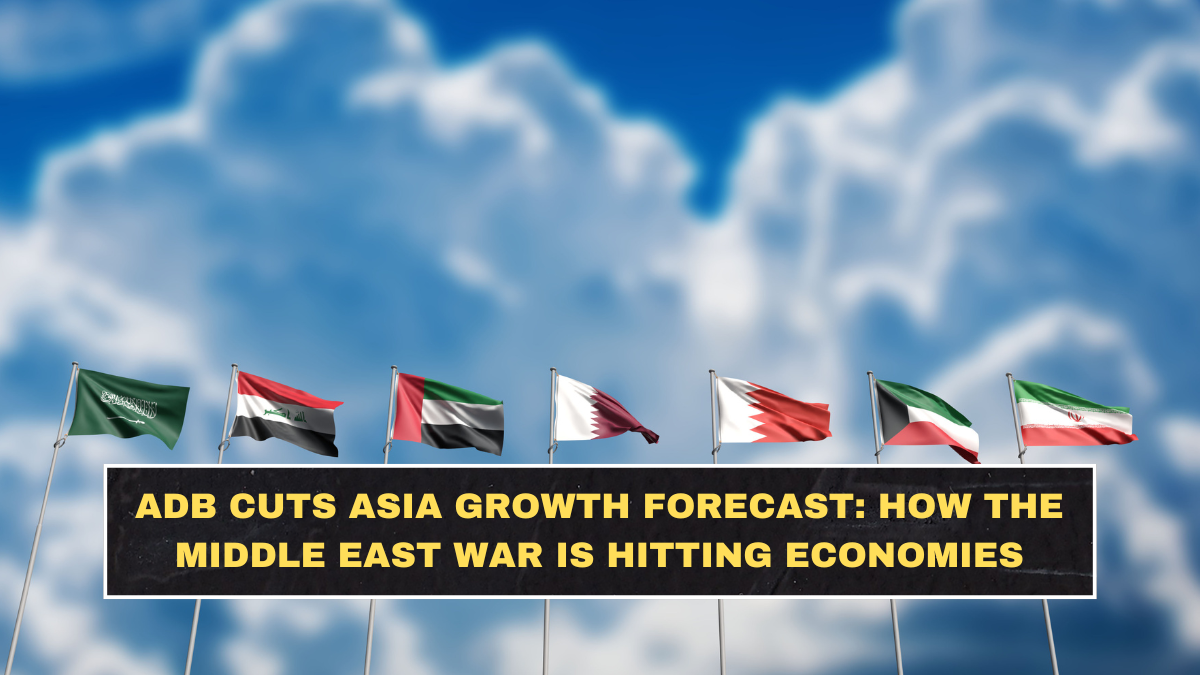
The Asian Development Bank cut its growth forecast for Asia and the Pacific because the Middle East war is now hurting energy prices, trade routes, inflation expectations and business confidence. Reuters reported that the ADB lowered its 2026 regional growth forecast to 4.7%, down from its earlier estimate of 5.1%. It also cut its 2027 forecast to 4.8%, again down from 5.1%.
That may look like a small percentage change, but it is not small when applied to a region as large as Asia. A few decimal points can represent billions of dollars in lost output, weaker hiring, slower investment and more pressure on governments. The warning is simple: the Middle East war is no longer a distant geopolitical event. It is now becoming an economic drag across Asia.
What Numbers Did The ADB Change?
The ADB’s revised numbers show a clear downgrade in confidence. Regional growth for Asia and the Pacific is now expected at 4.7% in 2026 and 4.8% in 2027. Inflation is also expected to rise sharply, with the ADB lifting its 2026 regional inflation forecast from 3.6% to 5.2%. That combination of slower growth and higher inflation is the exact situation policymakers hate.
The more worrying part is the downside scenario. Reuters reported that if oil prices remain high from May onward, regional growth could fall further to 4.2% in 2026 and 4.0% in 2027, while inflation could jump to 7.4% this year. That is not normal volatility. That is the kind of shock that can force central banks, finance ministries and businesses into defensive mode.
| Indicator | Earlier Forecast | New Forecast | Why It Matters? |
|---|---|---|---|
| 2026 regional growth | 5.1% | 4.7% | Slower expansion across Asia-Pacific |
| 2027 regional growth | 5.1% | 4.8% | Weakness may last beyond this year |
| 2026 inflation | 3.6% | 5.2% | Higher cost of living and business costs |
| Downside 2026 growth | Not base case | 4.2% | Possible if oil shock persists |
| Downside 2026 inflation | Not base case | 7.4% | Severe pressure on households |
How Is The Middle East War Damaging Asian Economies?
The Middle East war is damaging Asian economies mainly through energy costs. Many Asian countries import large amounts of oil and gas, so higher prices quickly raise costs for transport, electricity, factories, airlines and shipping. When businesses pay more for fuel, they either absorb lower profits or pass the cost to consumers. Neither option is good for growth.
The war is also disrupting confidence. Companies delay investment when energy prices swing sharply or shipping routes become risky. Governments become cautious because subsidies, fuel support and social spending become more expensive. Consumers spend less when petrol, food and electricity bills rise. That is how a war far from Asia can still slow growth across the region.
Which Countries Are Most Exposed?
The most exposed countries are energy importers with large transport needs, weaker currencies, high debt or limited room for subsidies. India, Thailand, the Philippines, Japan, South Korea and several Southeast Asian economies can all feel pressure when imported fuel becomes expensive. The exact impact differs, but the direction is similar: higher energy bills make everything harder.
Thailand shows the pressure clearly. Reuters reported that Thailand’s central bank kept its key rate at 1.00% while cutting its 2026 growth forecast to 1.5% from 1.9%. It also raised its inflation forecast to 2.9% from 0.3%, blaming higher global energy prices linked to the Middle East conflict.
Why Does Higher Oil Create Inflation So Quickly?
Oil creates inflation quickly because it sits inside almost every price. Fuel moves goods from ports to warehouses, powers buses and trucks, affects airline fares, and raises farming and manufacturing costs. Even people who do not own cars still pay indirectly when oil rises because shops, transport companies and food suppliers face higher expenses.
The World Bank has also warned about a wider energy shock. Reuters reported that the World Bank expects energy prices to rise 24% in 2026 because of Middle East war disruption, with Brent crude projected to average $86 per barrel and potentially rise to $115 if the conflict persists or deepens. That kind of price pressure does not stay inside oil markets. It leaks into food, transport and inflation everywhere.
Why Is This Dangerous For Central Banks?
This is dangerous for central banks because they face a bad trade-off. If inflation rises, they may want to keep interest rates higher. But if growth weakens, businesses and borrowers need relief. Cutting rates too soon can worsen inflation. Keeping rates too high can slow the economy even more. That is the policy trap created by an energy shock.
The ADB warned central banks to manage market volatility carefully and monitor inflation expectations. That wording matters because inflation can become self-reinforcing if people and businesses start expecting prices to keep rising. Workers demand higher wages, companies raise prices early, and governments face pressure to spend more. Once that cycle begins, it becomes harder to control.
How Could Trade And Investment Be Hit?
Trade can be hit through higher shipping costs, insurance premiums and delivery delays. If energy shipping routes remain risky, companies may hold more inventory, shift suppliers or delay expansion. That sounds technical, but the effect is simple: goods become more expensive and business becomes less predictable.
Investment also suffers when uncertainty rises. A factory owner thinking about expansion may pause. A logistics company may delay fleet purchases. A government may postpone infrastructure spending because fuel subsidies suddenly cost more. This is why growth downgrades matter. They reflect decisions that thousands of businesses and governments make when the future looks unstable.
What Is The Bottom Line?
The ADB’s forecast cut is a warning that Asia is entering a tougher economic phase. Growth is still positive, but the direction has weakened. Inflation is rising, oil risk is spreading, and the Middle East war is turning into a regional economic problem for Asia-Pacific.
The blunt truth is that Asia cannot treat energy security as a background issue anymore. A shock in the Gulf can hit factories in Vietnam, consumers in India, airlines in Japan and food prices across Southeast Asia. The ADB downgrade is not panic. It is a signal that the cost of war is now moving through the entire Asian economy.
FAQs
What Is The ADB’s New Asia Growth Forecast?
The Asian Development Bank now expects Asia and the Pacific to grow 4.7% in 2026 and 4.8% in 2027, down from its earlier forecast of 5.1% for both years.
Why Did The ADB Cut Its Forecast?
The ADB cut its forecast because the Middle East war has pushed up energy prices, disrupted trade networks and increased financial pressure across the region.
What Is The New Inflation Forecast For Asia?
The ADB raised its 2026 inflation forecast for Asia and the Pacific from 3.6% to 5.2%, showing that price pressure is rising sharply.
Which Asian Economies Are Most At Risk?
Energy-importing economies are most at risk because higher oil and gas prices raise transport, electricity, manufacturing and household costs.
Could Asia’s Growth Fall Further?
Yes. The ADB warned that if oil prices stay high, regional growth could fall to 4.2% in 2026 while inflation could rise to 7.4%.