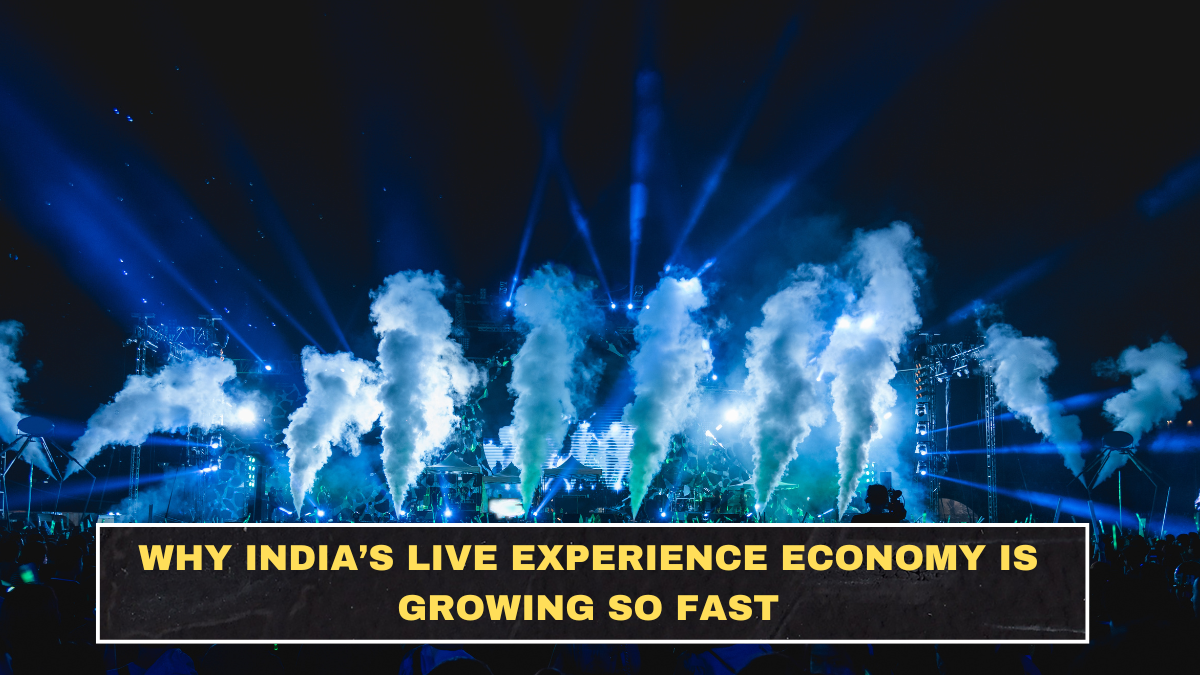
A lot of people still describe this as a “concert boom,” but that is too narrow. India’s media and entertainment sector reached about ₹2.78 lakh crore in 2025, up 9% year on year, and the latest FICCI-EY reporting says growth is being pushed by digital media, advertising, and the return of live events and experiences. The same outlook projects the sector could reach about ₹3.30 lakh crore by 2028. That means live experiences are not a side story anymore. They are becoming a meaningful part of how entertainment money now moves in India.
The more specific number is even harder to ignore. A recent BookMyShow-EY report put India’s live events market at around ₹13,000 crore. That is not small experimental spending. That is a serious consumer and brand market built around concerts, sports events, festivals, comedy, and cultural experiences. Once a category reaches that scale, it stops being lifestyle fluff and starts becoming a structural business shift.
What Is Driving the Surge
The first driver is simple: younger consumers are spending more on experiences they can participate in, not just passively consume. Reuters reported that India’s hotel industry is benefiting from major concerts and sporting events because younger consumers are increasingly prioritizing live experiences over traditional spending. That is a useful clue. People are not only buying tickets. They are building trips, social plans, and identity moments around events.
The second driver is that brands now see live events as stronger attention spaces than crowded digital channels. The BookMyShow-EY findings said 63% of attendees felt brands enhanced their overall event experience, while 29% reported improved brand imagery. That matters because advertisers are no longer just funding impressions. They are chasing emotional proximity. Live events give them something digital banners usually cannot: memory, energy, and physical presence.
The third driver is that sports, concerts, and fan culture are feeding each other. India’s sports economy crossed $2 billion in 2025, reaching ₹18,864 crore, according to WPP Media’s Sporting Nation report covered by The Economic Times. Cricket remains the core engine, but the broader point is that fandom itself is becoming more commercial, more mobile, and more event-driven.
IPL, Fan Parks, and Why Sport Is a Huge Piece of This Story
If you want proof that live experiences are spreading beyond stadium ticket holders, look at IPL Fan Parks. The IPL officially announced that the first phase of Fan Parks 2026 will run across 15 cities in 11 states over three weekends. These are not only metro locations. The list includes Rohtak, Mathura, Nizamabad, Ratnagiri, Meerut, Nadiad, and Rourkela. That tells you the live experience economy is moving into smaller-city India, not staying locked inside a few elite urban venues.
The Fan Park format matters too. The official IPL plan includes live screenings, food courts, kids’ zones, music, virtual batting, bowling nets, and photo booths. That is not just match viewing. It is designed as a spend-and-stay environment. People may come for cricket, but the event works because it packages sport as a social outing. That is exactly how experience economies grow: by turning attention into participation.
Table: What the Live Experience Economy in India Is Showing Right Now
| Signal | Current evidence | What it means |
|---|---|---|
| M&E sector growth | India’s M&E sector reached ₹2.78 lakh crore in 2025 and may hit ₹3.30 lakh crore by 2028 | Live experiences are part of a larger entertainment expansion |
| Live events market scale | India’s live events market is about ₹13,000 crore | This is already a real commercial category, not a niche trend |
| Sports economy growth | India’s sports economy crossed $2.1 billion in 2025 | Sports fandom is becoming a stronger spending engine |
| Regional fan expansion | IPL Fan Parks 2026 cover 15 cities in 11 states | Live sports experiences are spreading beyond metros |
| Travel spillover | Concerts and sporting events are driving hotel demand and event tourism | Experiences now influence tourism and local business activity |
Why People Are Spending More on Moments Than Things
The blunt answer is that moments now carry social and emotional value that ordinary purchases do not. A concert, fan park visit, or sports trip gives people something to share, remember, post, and talk about. That may sound obvious, but the business effect is real. Reuters reported that Coldplay’s Ahmedabad concert alone generated about $70 million in economic gains. That kind of spillover does not happen because people bought a ticket and went home quietly. It happens because events trigger wider spending across hotels, transport, food, and tourism.
There is also a cultural shift underneath this. Event-driven spending feels more justified to many consumers because it is tied to identity and community. Going to a major concert, joining an IPL fan gathering, or traveling for an event feels less like ordinary consumption and more like belonging to a moment. That is partly inference, but it is strongly supported by the way brands, hotels, and event businesses are reshaping plans around live demand.
Why This Matters for Businesses and Publishers
For businesses, the message is straightforward: consumers are not only buying products, they are buying participation. Hotels are already adjusting strategy around proximity to event venues, according to Reuters. Brands are putting more weight on immersive event marketing. Sports organizations are expanding fan formats into smaller cities. These are all signs of the same thing: experience-led demand now influences where companies invest.
For publishers, this is a strong content area because it connects entertainment, travel, youth spending, regional growth, sports, and consumer behavior in one beat. The mistake would be to treat it as celebrity coverage only. The smarter coverage is around what these events reveal about changing Indian spending habits, local economies, and fan behavior. That is where the real story sits.
Conclusion
India’s live experience economy is growing fast because events now do more than entertain. They create travel demand, local spending, stronger fan identity, brand value, and repeatable social habits. The numbers already show this is not random hype: a ₹13,000 crore live events market, a ₹2.78 lakh crore media and entertainment sector, a sports economy above $2 billion, and a clear spread of event formats beyond metros.
The real shift is simple. Indians are increasingly willing to spend on moments that feel memorable, social, and identity-rich. Anyone still dismissing that as a short-term concert craze is reading the market badly.
FAQs
What is India’s live experience economy?
It is the growing business around concerts, sports events, festivals, fan parks, comedy, and other in-person entertainment formats that people spend on for participation and memory, not just passive viewing.
How big is India’s live events market?
Recent reporting based on a BookMyShow-EY study put it at around ₹13,000 crore.
Why is IPL important to this trend?
Because the IPL is extending live fan experiences beyond stadiums through Fan Parks in 15 cities across 11 states, showing that sports-based live experiences are scaling into regional India.
Does this trend affect tourism and hotels too?
Yes. Reuters reported that concerts and major sporting events are lifting hotel demand, and event tourism is increasing spending and longer stays in places like Maharashtra.