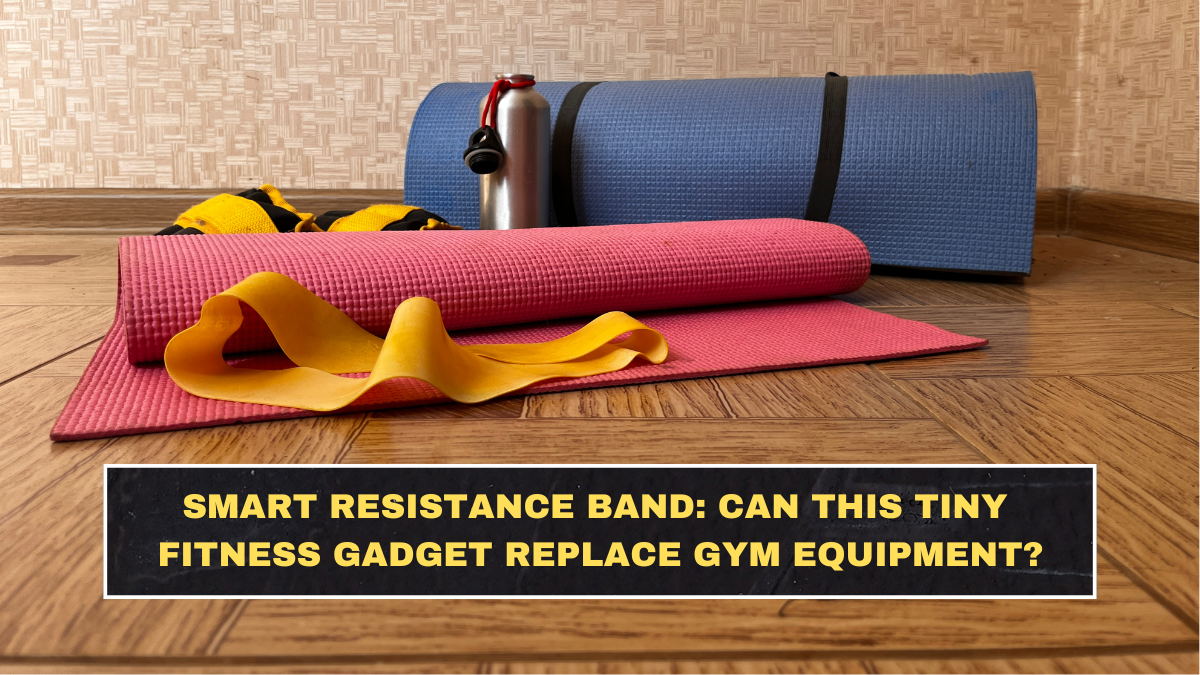
A smart resistance band is a connected fitness band that adds sensors, Bluetooth tracking, app guidance, and workout data to traditional resistance-band training. A normal resistance band gives elastic resistance when you stretch it. A smart version tries to measure things like reps, workout duration, pulling speed, power, resistance level, and progress over time.
Some smart bands connect to mobile apps and give audio or visual cues during workouts. Earlier connected resistance-band systems were designed to track reps, power, velocity, and exercise feedback through built-in or attached sensors. Fit&Well reported that some Bluetooth-connected resistance bands can track reps, power, and velocity while giving app-based cues if the user pulls too fast.
This is why smart resistance bands are getting attention. They are portable, cheaper than a full gym setup, and easier to store than dumbbells or machines. But let’s not be fooled by the word “smart.” The band is only useful if the user trains consistently and progressively.
How Does A Smart Resistance Band Track Workouts?
A smart resistance band tracks workouts by using sensors that detect movement, tension, pull speed, or repetition patterns. The data is usually sent to a phone app through Bluetooth. The app may then show how many reps you completed, how long you trained, how much force you used, and whether your pace or range of motion changed.
Some products use sensors attached to the band or handle, while others rely more on app-based exercise logging. SmartWorkout, for example, offers resistance-band workout tracking where users can record exercises, resistance levels, training dates, and notes to monitor progression over time.
| Feature | What It Tracks | Why It Helps |
|---|---|---|
| Rep tracking | Counts completed repetitions | Reduces guesswork during sets |
| Resistance logging | Records band level or estimated tension | Helps monitor progressive overload |
| Tempo feedback | Tracks speed of movement | Encourages controlled reps |
| App workouts | Guides exercise routines | Useful for beginners |
| Progress history | Stores workout data | Helps users stay consistent |
The useful part is not the gadget itself. The useful part is feedback. Most people train randomly at home, doing “some reps” until they feel tired. A smart band can create structure by showing whether training volume, resistance, and consistency are actually improving.
Can Smart Resistance Bands Build Muscle?
Yes, smart resistance bands can help build muscle if they are used with enough resistance, proper form, progressive overload, and consistency. Resistance bands create tension, and muscles respond to tension. That means bands can support strength, endurance, mobility, activation, and hypertrophy when programmed properly.
Research on elastic resistance training supports its usefulness. A 2019 systematic review and meta-analysis found that elastic resistance training produced strength gains that were not significantly different from conventional resistance training in the included studies. That does not mean bands are always equal to heavy weights, but it does show they are not useless toys.
The catch is progression. If the band becomes too easy and you keep doing the same 15 reps forever, your body has no reason to adapt. Smart tracking can help here because it reminds you when reps, resistance level, sets, or workout difficulty need to increase.
Can A Smart Resistance Band Replace Gym Equipment?
A smart resistance band can replace some gym equipment for beginners, travellers, home users, and people doing maintenance workouts. It can be very effective for rows, presses, curls, lateral raises, squats, glute bridges, pull-aparts, mobility work, rehab-style exercises, and warm-ups.
But it cannot fully replace a gym for serious strength training. Heavy squats, deadlifts, bench presses, pull-downs, leg presses, and heavy progressive loading are easier to manage with barbells, dumbbells, cables, and machines. Bands are portable and versatile, but their resistance curve is different because tension increases as the band stretches.
Tom’s Guide recently noted that resistance bands are useful for home and travel workouts, but they do not offer the same progressive overload as heavy weights. That is the honest middle ground. Bands can build fitness, but serious strength goals may still need heavier equipment.
Who Should Buy A Smart Resistance Band?
A smart resistance band makes sense for people who train at home, travel often, dislike gyms, need compact equipment, or want guided workouts without buying bulky machines. It is also useful for beginners who need structure and reminders, because the app can guide sessions and track consistency.
It can also help people returning to fitness after a break. Traditional bands are already common in physiotherapy, mobility, and activation work because they are light, controlled, and easy to scale. Smart tracking adds motivation and visibility, especially for users who like seeing progress data.
But if you already train seriously with weights and follow a proper programme, a smart band may be unnecessary. You may only need normal resistance bands for warm-ups, accessory work, or travel. Do not buy a smart gadget just because your discipline is weak. A device cannot fix laziness.
What Are The Biggest Benefits?
The biggest benefit is portability. A smart resistance band can fit in a bag, drawer, or suitcase. For people who travel, live in small apartments, or do not want gym memberships, that is a real advantage. You can train shoulders, back, arms, chest, legs, and core with one compact tool.
The second benefit is accountability. The app can track workouts, show progress, and reduce the “I think I trained enough” illusion. Data makes it harder to lie to yourself. If you skipped four days, the app will show it.
The third benefit is beginner guidance. Many people do not know which exercises to do, how many sets to perform, or how to progress. A smart band with a decent app can turn random home exercise into a more structured routine.
What Are The Downsides?
The biggest downside is durability. Resistance bands wear out over time. If a band cracks, frays, or snaps, it can cause injury. Adding sensors and smart parts also creates more things that can break, disconnect, or need charging. A normal band is simple; a smart band adds complexity.
The second downside is measurement accuracy. Fitness trackers are not always perfect, and resistance-band tracking can be tricky because band tension changes with stretch length, anchor position, and user height. If the app estimates force poorly, the data may look scientific without being fully reliable.
The third downside is cost. A regular resistance band set is cheap. A smart version can cost much more because of sensors, app features, subscriptions, or brand positioning. If you only need basic home exercise, a normal set may be the smarter buy.
Conclusion?
A smart resistance band is a useful home fitness gadget for people who want portable training, app guidance, rep tracking, and progress data. It can help beginners stay consistent and make resistance-band workouts feel more structured.
But it does not magically replace a full gym for serious strength goals. It is best for beginners, travellers, home workouts, mobility, accessory exercises, and maintenance training. If you want real results, the “smart” part is not the sensor. The smart part is progressive training, consistency, recovery, and honest effort.
FAQs
What Is A Smart Resistance Band?
A smart resistance band is a connected fitness band that uses sensors and an app to track workout data such as reps, resistance level, speed, duration, and progress over time.
Can Smart Resistance Bands Build Muscle?
Yes, they can help build muscle when used with enough resistance, good form, and progressive overload. However, they may not fully replace heavy weights for advanced strength training.
Are Smart Resistance Bands Better Than Normal Bands?
They are better for people who want app tracking, guided workouts, and progress data. Normal resistance bands are better for users who want a cheaper, simpler, and more durable option.
Who Should Buy A Smart Resistance Band?
It is best for beginners, home workout users, travellers, and people who want compact fitness equipment with guided tracking. Serious lifters may only need it as an accessory tool, not a full gym replacement.