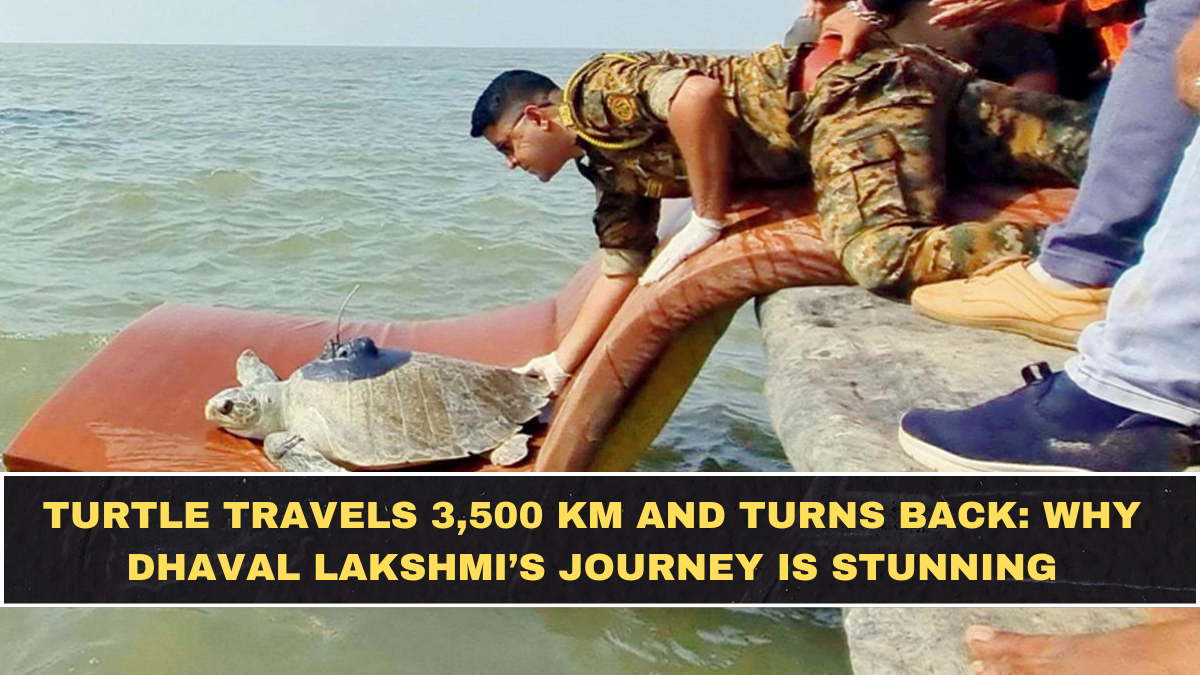
An Olive Ridley turtle named Dhaval Lakshmi has stunned conservation experts after travelling around 3,500 km across the Arabian Sea from Maharashtra, coming close to Oman, and then turning back toward Indian waters. The turtle was released from Dahanu in November 2025 with a satellite transmitter after being rescued and treated at the Dahanu Turtle Rescue Centre. Her route has become a rare conservation story because it shows how little we still know about sea turtle movement in the deep Arabian Sea.
This is not just a cute wildlife headline. Dhaval Lakshmi’s journey matters because satellite tracking can reveal migration routes, feeding zones and survival behaviour that humans would otherwise never see. If India wants to protect turtles seriously, it needs this kind of field data, not only emotional beach-cleanup posts and World Turtle Day slogans.
Who Is Dhaval Lakshmi?
Dhaval Lakshmi is a rescued Olive Ridley turtle found injured at Dhakat Beach in Dahanu, Maharashtra, in August 2025. She was treated for months at the Dahanu Turtle Rescue Centre and released on November 20, 2025, with a satellite transmitter attached to her shell. The turtle was reportedly named after late wildlife activist Dhaval Kansara, making her journey emotionally meaningful for conservation workers as well.
| Detail | Dhaval Lakshmi’s Journey |
|---|---|
| Species | Olive Ridley turtle |
| Rescue Location | Dhakat Beach, Dahanu |
| Release Date | November 20, 2025 |
| Tracking Method | Satellite transmitter |
| Total Journey | Around 3,500 km |
| Route | Maharashtra toward Oman, then back |
| Special Point | Only one among eight tracked turtles to take this deep-sea route |
| Latest Direction | Heading back toward Maharashtra coast |
Why Did The Route Surprise Experts?
Dhaval Lakshmi surprised experts because she did not simply move along the west coast like many tracked turtles. After staying near shore initially, she headed west into the Arabian Sea and by mid-January was more than 700 km from Dahanu. On February 26, she was tracked around 160 km off Masirah Island near Oman, a known turtle nesting area, before making a U-turn back toward Indian waters.
Mid-Day reported in late April that Dhaval Lakshmi was around 800 km west of Ratnagiri and moving southeast after briefly slowing in a productive zone, possibly linked to foraging. That detail matters because the journey is not random wandering. Turtles may be responding to food, ocean currents, temperature and instincts that scientists are still trying to understand.
Why Are Olive Ridley Turtles Important?
Olive Ridley turtles are among the smallest sea turtle species, known for their olive-green, heart-shaped shell and long-distance ocean movement. NOAA says Olive Ridleys are one of the most widespread sea turtles and are famous for arribada, a mass nesting event where thousands of females come ashore together. India is one of the globally important regions for this behaviour, especially on the eastern coast.
WWF India notes that Olive Ridley numbers have declined over the years and the species is listed as Vulnerable on the IUCN Red List. That is why every tracked movement matters. A single turtle’s path can help researchers identify marine corridors, risky fishing zones and possible feeding areas that need stronger protection.
What Does This Journey Teach Conservationists?
Dhaval Lakshmi’s journey shows that rescued turtles can survive and travel strongly after rehabilitation if treated properly. That is a major success for the Dahanu Turtle Rescue Centre because she was the only rehabilitated turtle among the eight Maharashtra-based tagged turtles and still completed the most dramatic route. This proves that rescue work is not only emotional; it can produce real survival outcomes.
Key lessons from the journey include:
- Satellite tracking can reveal hidden migration routes.
- Rescued turtles can return to strong ocean movement.
- The Arabian Sea may hold important turtle corridors.
- More tagged turtles are needed before making big conclusions.
- Conservation must cover beaches, fishing zones and deep-sea routes.
What Are The Biggest Threats To Olive Ridleys?
The biggest threats are fishing nets, accidental capture, plastic pollution, coastal development, beach lighting, climate change and disturbance at nesting sites. AP reported in 2025 that hundreds of endangered sea turtles had washed ashore near Chennai, with experts linking many deaths to fishing nets and poor use of turtle excluder devices. That shows the danger is not theoretical; turtles are dying in large numbers along Indian coasts.
The brutal truth is that people love turtle stories when they look inspiring, but conservation gets ignored when it demands inconvenience. Protecting turtles means regulating fishing practices, reducing plastic, controlling beach lighting and respecting nesting zones. Without that discipline, viral turtle stories will not save the species.
Conclusion: Why Does Dhaval Lakshmi’s Journey Matter?
Dhaval Lakshmi’s 3,500 km journey matters because it turns one rescued turtle into a moving lesson about ocean life, rehabilitation and conservation science. Her trip from Maharashtra toward Oman and back proves that satellite tracking can uncover routes that would otherwise remain invisible. It also shows that rescue centres can make a real difference when rehabilitation is serious and scientific.
But one successful turtle does not mean the problem is solved. Olive Ridleys still face deadly risks from fishing, pollution, coastal disturbance and habitat loss. Dhaval Lakshmi’s journey should not be treated only as a feel-good viral story. It should push India to invest more in tracking, rescue centres, safer fishing methods and real marine protection.
FAQs
Who Is Dhaval Lakshmi?
Dhaval Lakshmi is a rescued Olive Ridley turtle from Dahanu, Maharashtra. She was found injured at Dhakat Beach in August 2025, treated at the Dahanu Turtle Rescue Centre, and released on November 20 with a satellite transmitter. Her 3,500 km journey toward Oman and back has become a major conservation story.
How Far Did Dhaval Lakshmi Travel?
Dhaval Lakshmi travelled around 3,500 km across the Arabian Sea. She moved from Maharashtra toward the coast of Oman and then turned back toward Indian waters. Her latest tracked movement showed her heading back toward the Maharashtra coast after the long sea journey.
Why Is This Turtle Journey Important?
The journey is important because it gives scientists rare data about Olive Ridley movement in the Arabian Sea. It also shows that rehabilitated turtles can survive and travel long distances after release. Such tracking can help identify migration corridors, feeding zones and threats that need stronger protection.
Are Olive Ridley Turtles Endangered?
Olive Ridley turtles are listed as Vulnerable on the IUCN Red List, and their populations face serious threats. WWF India says their numbers have been declining, while threats include fishing nets, pollution, habitat loss and disturbance at nesting beaches. Conservation work is important because even common-looking species can decline quickly when threats are ignored.
Click here to know more