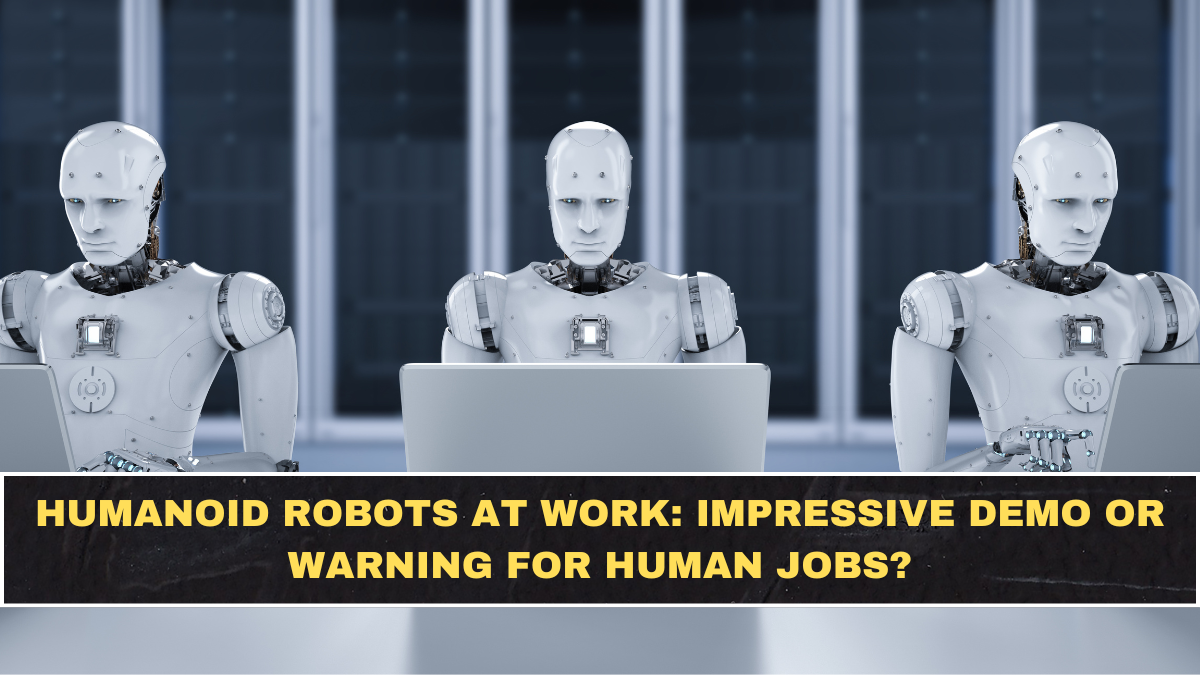
Humanoid robots are no longer just awkward machines walking on stage for viral videos. The conversation has changed because companies are now testing them in factories, warehouses and logistics environments where repetitive labour is expensive, tiring and hard to staff consistently. Figure AI recently livestreamed humanoid robots handling warehouse-style package work for an eight-hour shift using its Helix-02 autonomy system, turning a robotics demo into a serious workplace debate.
The real question is not whether the demo looked impressive. It did. The real question is whether humanoid robots can work reliably in messy real environments, around people, with changing tasks, errors, damaged packages, safety rules and business pressure. That is where the future of robot labour will be decided.
What Are Companies Testing?
Companies are testing humanoid robots for jobs that are physical, repetitive and structured enough for machines to learn. BMW has said it is piloting humanoid robots at its Leipzig plant as part of a broader push to bring “physical AI” into production, while Figure has also worked with BMW in production-related testing. These are not random science projects; they are early industrial trials aimed at real workplace integration.
| Workplace Use | Why Robots Fit | Human Job Risk |
|---|---|---|
| Package handling | Repetitive and measurable | Medium |
| Factory part movement | Structured workflow | Medium-High |
| Night-shift support | Labour shortage pressure | Medium |
| Basic inspection | Repeatable visual checks | Low-Medium |
| Heavy lifting support | Reduces fatigue risk | Medium |
Reuters also reported that British robotics company Humanoid plans to deploy up to 2,000 robots at Schaeffler plants by 2032, with early deployments expected from late 2026 into 2027. That shows manufacturers are not only watching demos; some are already planning larger rollouts.
Why Are Factories Interested?
Factories and warehouses are interested because humanoid robots promise flexibility. Traditional industrial robots are powerful, but they often need fixed cages, rails, special stations and narrow tasks. Humanoid robots are attractive because they are designed to move through human-built spaces, use human-like arms, reach shelves, lift objects and perform tasks without fully redesigning the workplace.
That promise is valuable because labour shortages, rising wages, safety concerns and productivity targets are pushing companies toward automation. If a robot can handle boring, repetitive, physically tiring work safely, management will obviously test it. Pretending companies will ignore that opportunity is naive.
Is This A Warning For Workers?
Yes, but not in the childish “all jobs disappear tomorrow” way. The first jobs under pressure will be repetitive physical roles where tasks are predictable, output is easy to measure and robots can be supervised by a small human team. Warehouse sorting, parts movement, loading, unloading and simple factory assistance are the obvious early targets.
Workers should not panic, but they should not laugh this off either. The dangerous mindset is believing robots must become perfect before they matter. They do not. They only need to become good enough at selected tasks to change hiring, staffing levels and wage pressure in those areas.
Where Will Humans Still Matter?
Humans will still matter wherever judgment, customer handling, exception management, repair decisions, supervision, safety response and flexible problem-solving are needed. A robot may move boxes, but humans still design workflows, handle breakdowns, manage unusual cases, ensure quality and make accountability decisions when something goes wrong.
The future workplace may look less like “robots replace everyone” and more like “fewer humans supervise more automated work.” That is still a serious shift. It means workers need to become better at operating systems, monitoring automation, handling exceptions, basic technical troubleshooting and using AI tools.
Key skills that may matter more:
- Robot supervision and workflow monitoring
- Safety checks around automated systems
- Basic technical troubleshooting
- Data reporting and process improvement
- Human-machine coordination
- Quality control and exception handling
What Could Stop The Hype?
The biggest obstacles are reliability, cost, battery life, safety and maintenance. A robot that works in a demo is not automatically ready for a noisy factory floor. Real workplaces include broken items, poor lighting, human movement, tight spaces, emergency stops, software bugs and unexpected objects.
Cost will be the brutal filter. If humanoid robots are too expensive to buy, maintain and insure, companies will keep them in pilot projects. If they become cheaper, safer and more reliable, adoption will accelerate quickly. The winner will not be the robot with the best viral video; it will be the robot that delivers measurable return on investment.
Conclusion
Humanoid robots at work are both impressive and a warning. The latest demos show real progress in physical AI, long-duration operation and workplace automation. Factory pilots and planned deployments suggest that major companies are taking this seriously, especially for repetitive industrial and logistics tasks.
The blunt takeaway is this: humanoid robots are not ready to replace every worker, but they are becoming good enough to challenge specific jobs. Workers, companies and governments should prepare now. Laughing at robots because they still make mistakes is lazy thinking; the smarter move is to learn how work changes when robots become regular colleagues.
FAQs
What Are Humanoid Robots Used For At Work?
Humanoid robots are being tested for package handling, factory part movement, warehouse sorting, basic inspection, loading support and repetitive physical tasks. These jobs are attractive for automation because they are structured, tiring and measurable.
Will Humanoid Robots Replace Human Workers?
Humanoid robots may replace some repetitive tasks, but they are unlikely to replace all workers soon. Humans will still be needed for supervision, safety, decision-making, repairs, quality control and handling unusual workplace situations.
Why Are Companies Testing Humanoid Robots?
Companies are testing humanoid robots because they may reduce labour pressure, improve productivity, handle repetitive work and fit into human-designed spaces better than fixed industrial robots. The main attraction is flexible automation.
What Jobs Are Most At Risk From Humanoid Robots?
The most exposed jobs are repetitive physical roles in warehouses, factories and logistics centres. Package sorting, material movement, basic loading and structured assembly support are likely to face automation pressure first.