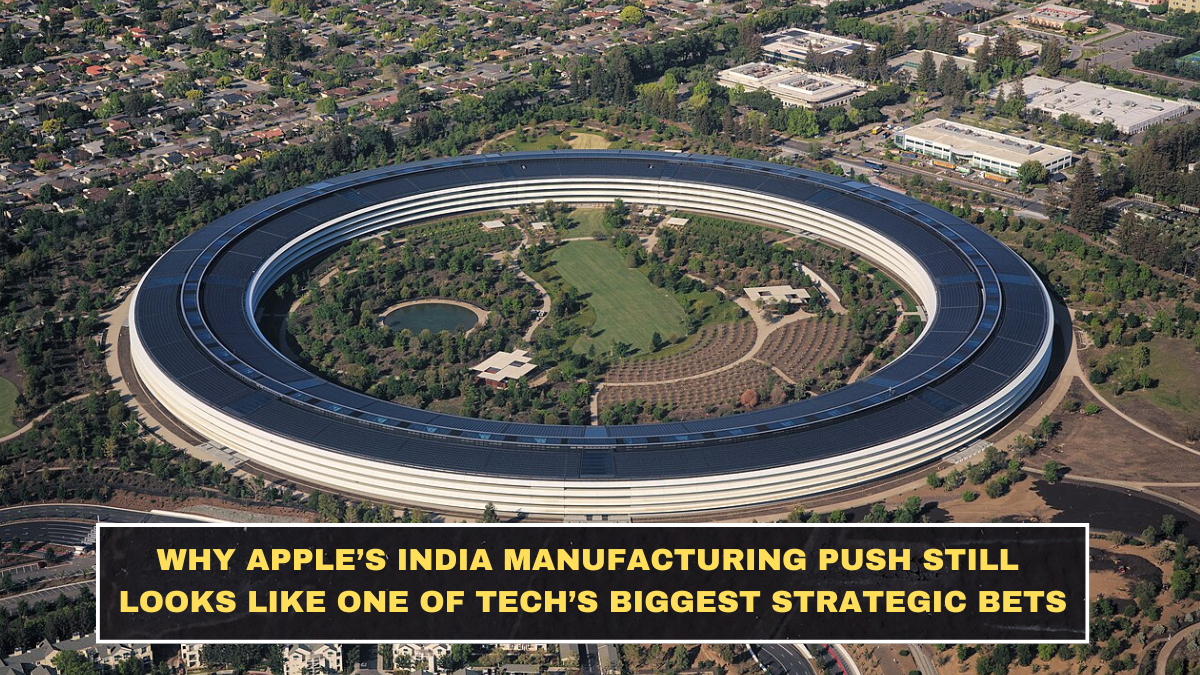
Apple’s India push still matters because it is no longer a trial run. It is now a serious supply-chain shift backed by factories, exports, policy changes, and big supplier bets. Reuters reported that Apple aims to make most iPhones sold in the US in India by the end of 2026, a sharp sign that the company wants less dependence on China as trade and tariff risks remain hard to ignore.
Why India matters so much to Apple now
The blunt reason is concentration risk. China is still Apple’s main production base, but the company has been trying to reduce overreliance on one country since pandemic disruptions and worsening US-China tensions exposed how fragile that model could be. Reuters reported in 2025 that India accounted for about 18% of global iPhone production, while China still handled roughly 75%. That gap shows two things at once: India has already become meaningful, and Apple still has a lot more room to shift.
Tata and Foxconn are the core of the India story
This is not some vague “Apple in India” narrative. It runs through specific manufacturers. Reuters reported that Tata Electronics started iPhone production at a new plant in Hosur, Tamil Nadu, while Foxconn was close behind with a major Bengaluru facility. Together, Tata and Foxconn were set to operate five iPhone manufacturing facilities in India. Reuters also reported that Tata bought a 60% stake in Pegatron’s India arm, giving Tata a stronger role in Apple’s local production network.
The numbers show India is already a serious export hub
A lot of lazy coverage still talks about India as if it is just a future backup plan. That is outdated. Reuters reported that India produced $60 billion worth of mobile phones in fiscal 2024-25 and exported $21.7 billion, making phones India’s top exported product. On Apple specifically, Reuters reported that Foxconn exported $1.31 billion worth of smartphones from India in March 2025 alone, and Apple airlifted about $2 billion worth of iPhones from India in that month as tariff worries rose.
Apple’s India manufacturing picture in simple terms
| Area | Confirmed detail | Why it matters |
|---|---|---|
| US supply goal | Apple aims to make most US-bound iPhones in India by end-2026 | Shows India is central to Apple’s near-term strategy. |
| Production share | India accounted for about 18% of global iPhone production in 2025 reporting | India is already meaningful, not symbolic. |
| Supplier footprint | Tata and Foxconn together were set to run five iPhone facilities in India | Scale is being built through multiple plants. |
| Export strength | India exported $21.7 billion in phones in FY2024-25 | The ecosystem is becoming export-driven. |
| Policy support | India changed tax rules in 2026 to let foreign firms provide equipment without triggering tax risk in bonded zones | This directly helps Apple and lowers supplier costs. |
| Foxconn investment | Foxconn announced a $1.5 billion investment in its India unit in 2025 | Suppliers are still putting serious money behind the shift. |
Policy is helping the strategy, not just the factories
This part matters more than many people realize. Reuters reported in February 2026 that India changed its tax treatment so foreign firms can provide manufacturing equipment in customs-bonded zones without creating a “business connection” that would expose them to income-tax risk. That sounds technical, but it is not minor. Apple had reportedly pushed for that change because advanced iPhone machinery is expensive, and making suppliers bear all of that cost slowed expansion. In plain language, India made a rule change that helps Apple scale faster.
Why this is still a strategic bet, not a completed transition
Do not fool yourself into thinking Apple has “moved to India.” It has not. China still dominates Apple’s manufacturing base, and Reuters also reported that setbacks such as a fire at a Tata component plant could force Apple to source parts from China again when disruptions hit. India is growing fast, but it is still building depth in components, logistics, and resilience.
A few clear takeaways matter here:
- India is becoming more important because Apple wants tariff and geopolitical flexibility
- Tata is no longer a side player; it is now a core Apple manufacturing partner
- Foxconn remains essential because it still handles major export volumes and investment
- India’s government is actively adjusting policy to keep the Apple ecosystem growing
Conclusion
Apple’s India manufacturing push still looks like one of tech’s biggest strategic bets because it is backed by hard evidence, not slogans. The production share is rising, exports are large, Tata and Foxconn are expanding, and India is changing policy to make the shift easier. But the transition is not finished, and anyone pretending Apple can replace China overnight is overselling it. The real story is that India has moved from backup option to essential second pillar in Apple’s supply chain.
FAQs
Why is Apple making more iPhones in India?
Mainly to reduce dependence on China and manage tariff and geopolitical risks more effectively.
How important is India in Apple’s supply chain now?
Reuters reported that India accounted for about 18% of global iPhone production in 2025-related reporting, which makes it a serious manufacturing base already.
What role do Tata and Foxconn play?
They are Apple’s key India manufacturing partners, with Tata expanding through new plants and the Pegatron India deal, while Foxconn continues to invest heavily and export large volumes.
Is Apple moving all production out of China?
No. China remains Apple’s main manufacturing base. India is becoming a stronger second pillar, not a full replacement yet.
What changed in India’s policy in 2026?
India allowed foreign firms to provide equipment in bonded manufacturing zones without triggering certain tax risks, a move Reuters said benefits Apple and other foreign manufacturers.