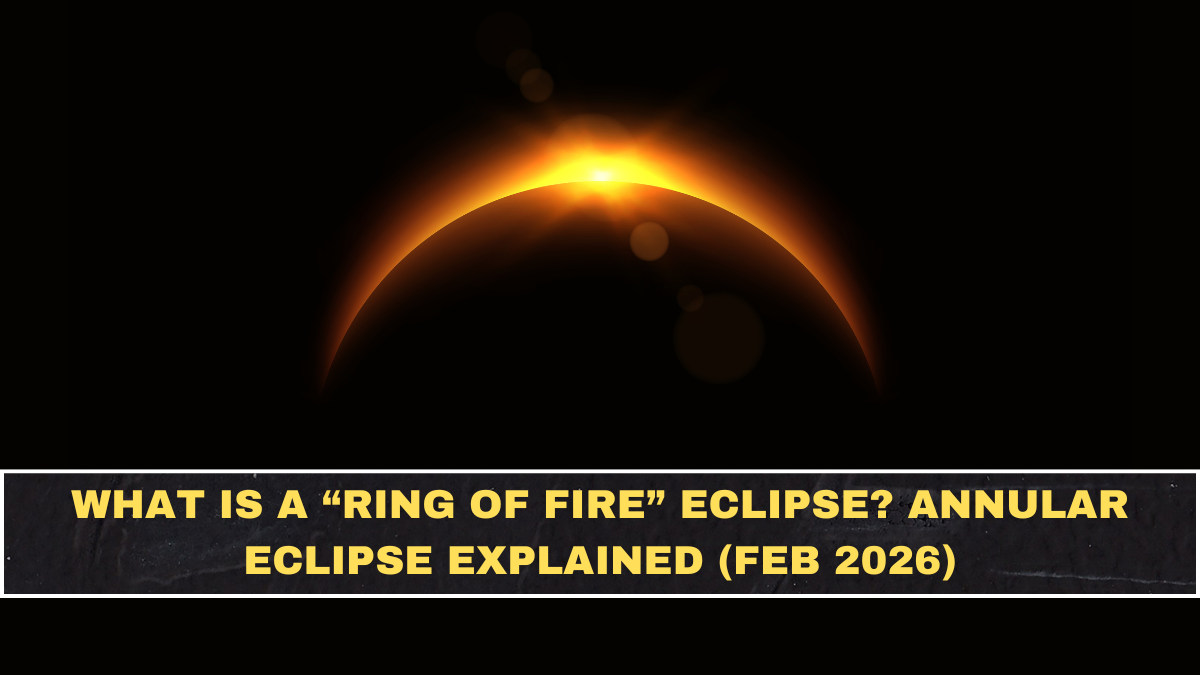
Astronomical events often generate huge public curiosity, and the annular eclipse ring of fire phenomenon is one of the most searched sky events whenever it occurs. Unlike a total solar eclipse that completely blocks the Sun, an annular eclipse creates a bright circular ring of sunlight around the Moon. This glowing ring appearance is what people commonly call the “ring of fire,” and it happens because of the Moon’s distance from Earth during the alignment.
Interest in the annular eclipse ring of fire increases every time such an event approaches because many people assume it will be visible everywhere, which is not true. Only specific regions on Earth fall within the narrow viewing path where the ring effect appears. Understanding what an annular eclipse actually is, how the path works, and why most locations cannot see the full effect helps people interpret the event correctly and avoid misinformation.
What Is an Annular Eclipse and Why It Creates a Ring of Fire
An annular eclipse happens when the Moon passes directly between the Earth and the Sun but does not fully cover the Sun’s disk. This occurs because the Moon follows an elliptical orbit around Earth, meaning its distance from Earth changes continuously. When the Moon is farther away, it appears slightly smaller in the sky and cannot block the Sun completely.
During this alignment, the center of the Sun is covered while the outer edge remains visible as a bright ring. This circular glow surrounding the Moon creates the annular eclipse ring of fire effect. Unlike a total solar eclipse, where the sky becomes dark for a short period, an annular eclipse still allows significant sunlight to pass through.
The visual result is dramatic but different from total darkness. The Sun appears as a bright halo in the sky, and environmental lighting changes only slightly compared to a total eclipse.
How the Annular Eclipse Path Works
The annular eclipse ring of fire is visible only along a narrow track on Earth called the path of annularity. This path forms because the Moon’s shadow touches only a limited portion of Earth’s surface during the eclipse. Areas directly under this shadow experience the full ring effect.
Regions outside this central path see only a partial solar eclipse, where the Moon covers part of the Sun but does not create the complete ring shape. The level of coverage decreases further away from the path.
The location of the annular path changes with each eclipse because it depends on orbital alignment between the Sun, Moon, and Earth. This is why some countries experience the ring effect while others do not see the eclipse at all.
Why Most People Cannot See the Ring of Fire Directly
One of the most common misunderstandings about the annular eclipse ring of fire is that it will be visible globally. In reality, the ring effect is limited to specific geographic regions under the direct alignment zone.
The Moon’s shadow is relatively small compared to Earth’s size, so only certain parts of the planet fall within the viewing corridor. Observers outside this corridor either see a partial eclipse or no eclipse at all.
This limited visibility is why many viewers rely on live broadcasts from observatories located along the annular path. These broadcasts allow people worldwide to witness the ring effect even when it is not visible from their location.
Difference Between Annular and Total Solar Eclipses
Although both events involve the Moon passing in front of the Sun, the visual experience differs significantly between an annular eclipse and a total solar eclipse. In a total eclipse, the Moon completely covers the Sun, causing temporary darkness and allowing the Sun’s outer atmosphere to become visible.
In an annular eclipse ring of fire event, the Moon appears smaller and cannot block the entire Sun. As a result, a bright ring remains visible and the sky never becomes fully dark. Environmental changes such as temperature drops and shadow distortion are usually less dramatic.
Understanding this difference helps explain why annular eclipses, while visually striking, do not produce the same level of darkness or atmospheric changes as total eclipses.
Why the Moon Appears Smaller During an Annular Eclipse
The apparent size of the Moon in the sky depends on its distance from Earth. When the Moon is closer, it appears larger and can fully cover the Sun during a total eclipse. When it is farther away, its apparent size decreases slightly.
During an annular eclipse ring of fire event, the Moon is near the farthest point in its orbit, called apogee. Because of this increased distance, the Moon cannot completely block the Sun’s surface.
This orbital variation is a natural part of celestial mechanics and explains why different types of solar eclipses occur at different times.
Safety Rules for Viewing a Ring of Fire Eclipse
Observing an annular eclipse ring of fire requires the same safety precautions as viewing any solar eclipse. Direct exposure to sunlight during an eclipse can cause permanent eye damage if proper protection is not used.
Safe viewing practices include:
-
Using certified solar viewing glasses designed specifically for eclipse observation
-
Viewing the eclipse through approved solar filters attached to telescopes or binoculars
-
Using indirect viewing techniques such as projection methods
-
Watching professional live broadcasts if safe viewing equipment is unavailable
Regular sunglasses or improvised filters do not provide adequate protection and should never be used.
Scientific Importance of Annular Solar Eclipses
Annular eclipses provide valuable scientific opportunities for studying solar radiation and Earth’s atmospheric response to changes in sunlight. Researchers analyze variations in temperature, light intensity, and atmospheric conditions during the event.
The annular eclipse ring of fire also helps scientists understand orbital dynamics and the precise movement of celestial bodies. These observations contribute to long-term research in astronomy and space science.
Beyond research value, such events increase public interest in science and encourage awareness of astronomical phenomena.
Conclusion: Why the Annular Eclipse Ring of Fire Fascinates People
The annular eclipse ring of fire continues to capture global attention because it offers a rare visual demonstration of celestial alignment. The glowing ring effect, limited viewing path, and precise orbital conditions make it one of the most fascinating astronomical events observable from Earth.
Understanding how an annular eclipse works, why visibility varies, and how to observe safely allows people to appreciate the event accurately. Even when not visible locally, the annular eclipse ring of fire remains a reminder of the dynamic relationship between Earth, the Moon, and the Sun.
As interest in skywatching grows in 2026, events like this help connect scientific understanding with everyday curiosity, making astronomy more accessible to the public.
FAQs
What is an annular eclipse ring of fire?
It is a type of solar eclipse where the Moon covers the center of the Sun but leaves a bright circular ring of sunlight visible.
Why does the ring of fire occur?
The ring appears because the Moon is farther from Earth and looks smaller, so it cannot completely block the Sun.
Can everyone see the ring of fire eclipse?
No, only regions within the narrow path of annularity can see the full ring effect. Other areas see a partial eclipse or no eclipse.
Is it safe to view an annular eclipse directly?
No, direct viewing without certified solar protection can damage eyesight. Proper viewing equipment must always be used.
How is an annular eclipse different from a total eclipse?
A total eclipse blocks the Sun completely and causes temporary darkness, while an annular eclipse leaves a bright ring visible.
Why is the annular eclipse important scientifically?
It helps scientists study solar radiation, atmospheric effects, and orbital mechanics while also increasing public interest in astronomy.