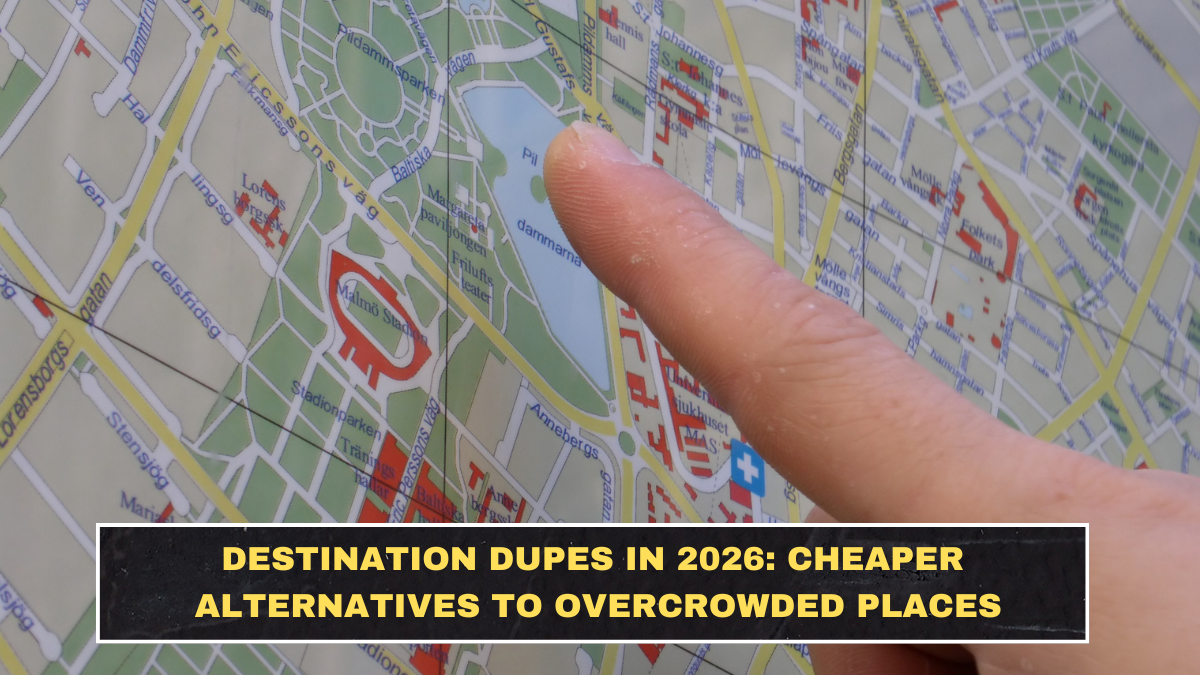
Destination dupes are not just another social media travel gimmick. In 2026, they reflect something more practical: travelers want the feel of famous places without the crowding, inflated prices, and stress that now come with many major hotspots. Expedia called this broader idea “Detour Destinations” in its Unpack ’25 report, saying 63% of consumers were likely to visit a less-crowded alternative near a major hotspot. GetYourGuide’s February 2026 data points in the same direction, describing a clear shift toward secondary cities and culturally rich alternatives that feel more affordable and more authentic.
That shift is not hard to understand. Overtourism is no longer some niche policy word. It is a real travel problem, especially across popular European cities and resort zones. UN Tourism has published work specifically on managing overtourism in urban destinations, while European tourism policy discussions in 2026 continue to frame overcrowding and tourism imbalance as serious issues. At the same time, Skyscanner’s 2026 travel trends say cost of living remains top of mind, with travelers shaping trips around what feels worth it at the right price. Put simply, destination dupes are growing because mainstream travel got too crowded, too expensive, and too predictable.
What are destination dupes in simple terms?
A destination dupe is a cheaper or less-crowded alternative to a famous place that delivers a similar mood, landscape, cultural feel, or travel experience. It is not about pretending one place is identical to another. That is shallow thinking. It is about asking a smarter question: if you want beach culture, old-town charm, food, architecture, or mountain scenery, do you really need the most overexposed version of it? Expedia’s detour concept and GetYourGuide’s “second cities” framing both make that logic clear.
The trend is also tied to behavior, not just budget. GetYourGuide said 38% of travelers in its 2025 survey were motivated by saving money when choosing lookalike alternatives with fewer crowds, and 45% of American travelers cited cost savings as a top reason to choose a dupe destination. French travelers, meanwhile, leaned more toward reducing overtourism pressure. That tells you the trend is not driven by one single motive. It is cost, crowd avoidance, and a search for a better overall experience.
Why are destination dupes getting bigger in 2026?
Because travelers are getting more rational. Skyscanner’s 2026 trends say travelers are planning with greater purpose and that price still matters, while Expedia’s 2025 trend report showed strong interest in alternatives near major hotspots. Those two things fit together neatly. When travel gets expensive and famous destinations get oversaturated, people stop assuming the biggest-name destination is automatically the best choice.
There is also a backlash against overtourism itself. European and global tourism bodies are discussing how to manage unbalanced tourism because overcrowding strains housing, local infrastructure, and resident tolerance. So travelers are not just chasing bargains. Many are reacting to the fact that heavily visited places can feel less enjoyable now than they did a decade ago. A trip loses its value when every viewpoint is packed, every meal is overpriced, and every street feels like a queue.
How do destination dupes actually help travelers?
They usually help in three ways: lower costs, lighter crowds, and a less manufactured travel experience. Lower costs matter because airfare and accommodation shape the whole trip budget. Skyscanner’s 2026 trends emphasize value-driven planning and highlight best-value destinations based on flight price drops. Lighter crowds matter because crowding affects everything from hotel prices to how much time is wasted. And the experience side matters because many travelers increasingly want a place that still feels lived-in rather than completely flattened by tourism.
| Travel problem | Why it happens in famous hotspots | Why a dupe can work better |
|---|---|---|
| High prices | Strong demand pushes up flights and hotels | Secondary cities can offer better value |
| Overtourism | Too many visitors in concentrated areas | Smaller alternatives often feel less chaotic |
| Generic experience | Hotspots get optimized for tourists | Dupes can feel more local and less staged |
| Booking pressure | Big-name places fill fast | Alternatives may offer more flexibility |
What kinds of destination dupes are people choosing?
The pattern is usually “big icon, nearby alternative” or “same vibe, less hype.” Expedia’s 2025 detour list included places like Reims instead of Paris, Brescia instead of Milan, Girona instead of Barcelona, and Abu Dhabi instead of Dubai. That does not mean those places are hidden. It means they can deliver a related cultural or geographic appeal without the same pressure.
The bigger point is not the specific pairings. It is the strategy. Travelers are increasingly willing to build a trip around a region rather than a single overexposed city. That is a smarter way to travel in 2026 because it widens options and usually improves price and comfort at the same time. GetYourGuide explicitly says travelers are leaning into secondary cities for affordability, authenticity, and cultural immersion rather than just ticking off famous landmarks.
Where is this trend heading next?
It is heading toward more deliberate, experience-first travel. Skyscanner says 2026 travel is becoming more personal and more purpose-driven, while GetYourGuide says people increasingly want affordable and authentic alternatives. That means destination dupes are likely to keep growing, especially as overtourism and travel costs remain live issues. But there is an obvious warning here too: once every “dupe” gets turned into content bait, it can become overcrowded as well. So travelers chasing dupes blindly may just recreate the same problem somewhere else.
Conclusion?
Destination dupes in 2026 make sense because travel has become too expensive and too crowded for lazy decision-making. Travelers are increasingly choosing cheaper, less chaotic alternatives not because they cannot afford the famous version, but because the famous version often delivers worse value. That is the real shift. The smartest travelers are no longer asking, “Where is everyone going?” They are asking, “Where can I get the experience I want without paying extra for hype?”
FAQs
Are destination dupes just a social media trend?
No. Travel companies and research-backed travel reports are treating them as a real consumer behavior shift tied to cost, overtourism, and authenticity.
Why are travelers choosing destination dupes in 2026?
The main reasons are lower costs, fewer crowds, and a better overall experience. Price pressure and overtourism are both major drivers.
Are destination dupes always close to the original hotspot?
Not always. Some are nearby secondary cities, while others simply offer a similar feel without being geographically next door. Expedia’s “detour” framing leans toward nearby alternatives, but the broader dupe idea is wider than that.
Can destination dupes become overcrowded too?
Yes. Once too many people chase the same “alternative,” it can start losing the very advantages that made it appealing in the first place. That is the flaw people keep ignoring.