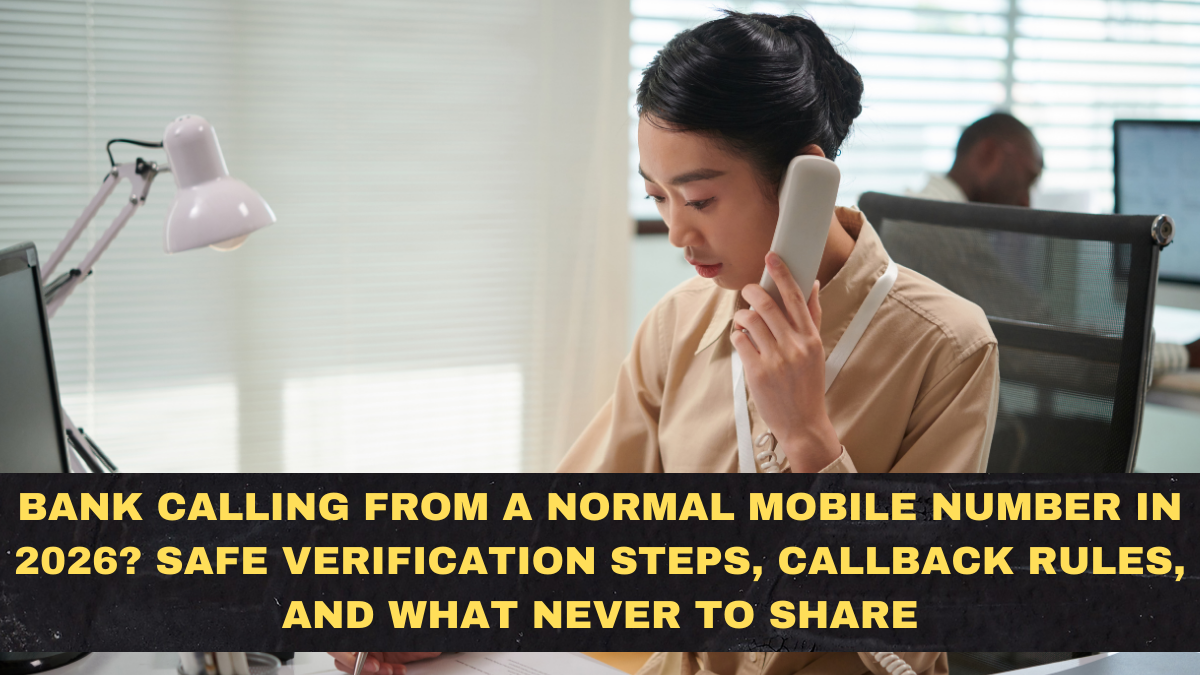
In 2026, one of the most confusing and dangerous situations for Indian banking customers is receiving a call that claims to be from a bank but comes from a normal mobile number. The caller sounds professional, knows your name, references your account or card, and speaks with calm authority. Most people instinctively assume it must be legitimate because it “sounds official.”
This is exactly why this scam pattern works so well.
After the introduction of the 1600 series for regulated service calls, banks are no longer supposed to contact customers for service or transactional purposes from ordinary mobile numbers. That single rule should have made verification easy. Instead, public confusion and partial awareness have created a new fraud opportunity.
This article explains what it actually means if a bank calls you from a normal number in 2026, why this is almost always a scam, how fraudsters structure these calls, and the only safe verification flow that protects your money and identity.
Why Banks Should Not Call From Normal Mobile Numbers Anymore
In 2026, Indian banks are required to use identifiable service number ranges for transactional and service calls. This was introduced to eliminate impersonation fraud and give customers a simple authenticity filter.
That means any genuine service call from your bank should now originate from a registered service number range, not from a random 10-digit mobile number.
If someone claiming to be from your bank calls from a normal number, that alone is a critical red flag.
Why People Still Fall for “Normal Number” Bank Calls
People fall for these calls because the fraudsters are no longer using obvious scare tactics. In 2026, scam callers sound calm, professional, and helpful.
They introduce themselves as relationship managers, verification officers, or fraud-prevention executives. They claim they are calling to “protect” your account or “complete a mandatory security check.”
This framing positions the scammer as a helper, not a threat.
How These Bank Impersonation Calls Are Structured
The structure is always the same.
First, the caller establishes legitimacy using your name, card type, or partial account details obtained from leaked databases.
Then they create mild urgency by saying something like your card will be blocked, your KYC is expiring, or suspicious activity was detected.
Finally, they offer a simple solution that requires OTP sharing, app installation, or UPI authorization.
At no point do they sound aggressive or criminal.
Why the 1600 Series Changed the Scam Playbook
Before 2026, scammers could easily pretend to be banks because real banks also used mobile numbers.
After the 1600 rule, direct impersonation became riskier.
So scammers adapted.
Now they claim to be third-party verification agencies, cybersecurity teams, or compliance partners “working with” your bank. This narrative loophole allows them to justify calling from a normal number while still sounding official.
This is a psychological bypass of the regulation.
What a Genuine Bank Will Never Ask You on a Call
This is non-negotiable.
No genuine bank in India will ever ask you for OTPs, card CVV numbers, UPI PINs, net-banking passwords, or remote-access app installations during a call.
Any request for these is not verification.
It is account takeover in progress.
There are zero exceptions to this rule.
Why “They Knew My Details” Does Not Mean It’s Legit
Many victims say the same thing after getting scammed.
“They knew my card type.”
“They knew my last transaction.”
“They knew my address.”
This does not mean the caller is your bank.
In 2026, personal data leaks are widespread. Fraud networks buy customer data in bulk from dark markets and data breaches.
Personalization is now part of the scam script.
The Only Safe Way to Verify a Bank Call in 2026
The rule is brutally simple.
Hang up.
Then call your bank’s official customer-care number from the back of your debit card or your bank’s official mobile app.
Do not redial the incoming number.
Do not trust callback numbers given by the caller.
If the call was genuine, your bank will already have a record of the attempted outreach.
This single habit neutralizes almost all bank-call scams.
Why Continuing the Call Is Already a Risk
Even if you do not share OTPs or PINs, continuing the conversation itself increases risk.
Scammers extract behavioral data, confirmation responses, and emotional vulnerabilities that they can use in future calls.
The safest response to a suspicious bank call is polite disengagement, not cautious conversation.
Why Blocking the Number Is Not Enough
Most scam operations rotate numbers constantly.
Blocking a number stops one instance, not the scam network.
Reporting and verification discipline matter far more than blocking.
Blocking gives emotional relief, not financial protection.
Why People Break Their Own Safety Rules
Because scams succeed emotionally, not logically.
Fear of account blockage, embarrassment about KYC issues, and urgency about suspicious activity override rational thinking.
Even people who know the rules break them under pressure.
This is why bank-call safety must become muscle memory, not just knowledge.
What the 1600 Rule Does and Does Not Guarantee
The 1600 rule makes impersonation easier to detect.
It improves complaint enforcement.
It reduces confusion.
It does not guarantee that a call is genuine.
It does not protect against emotional manipulation.
It does not replace behavioral discipline.
It is a filter, not a firewall.
Conclusion: If a “Bank” Calls From a Normal Number, Assume It’s a Scam
In 2026, the rule is brutally simple.
If someone claims to be from your bank and calls from a normal mobile number, assume it is a scam.
Do not debate.
Do not verify during the call.
Do not share anything.
Hang up.
Call your bank yourself using official numbers.
This single habit will protect you from most financial fraud.
The 1600 series changed the rules.
Scammers changed their scripts.
Your behavior now matters more than ever.
FAQs
Can banks legally call from normal mobile numbers in 2026?
No. Genuine service calls must use regulated service number ranges.
What if the caller knows my bank details?
That does not prove legitimacy. Data leaks are common.
Should I continue the call cautiously to verify?
No. Hang up and call back using official numbers.
Do banks ever ask for OTPs or PINs on calls?
No. Any such request is always a scam.
What if the call sounds very professional and calm?
Scammers now sound professional. Tone is not proof.
Is blocking the number enough?
No. Blocking does not stop scam networks.