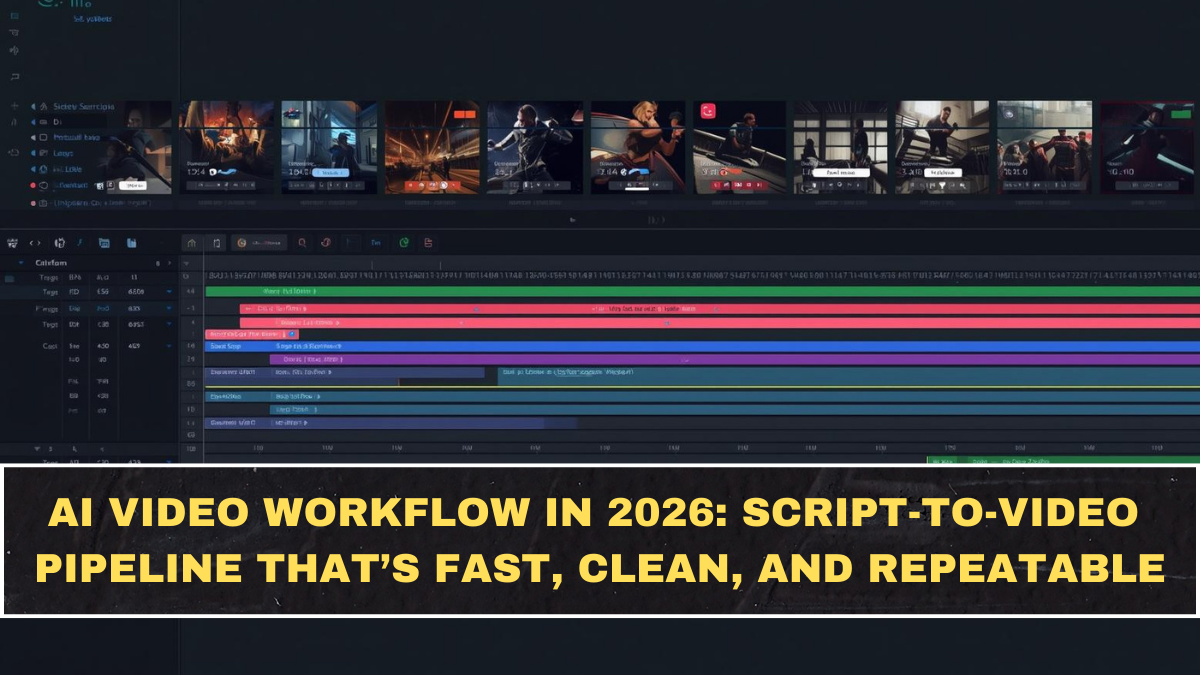
AI video creation in 2026 is no longer about experimenting with tools. It is about building a repeatable pipeline that turns ideas into publishable videos consistently, without burning time or quality. Creators who succeed are not the ones with the fanciest tools, but those with workflows that reduce friction at every step. A clean pipeline matters more than any single AI feature.
What changed is expectation. Audiences now expect frequent, polished video output across platforms, while creators want sustainability. This tension is resolved through structured AI workflows that balance automation with human judgment. The result is faster production without the “AI look” that turns viewers away.
Why Workflow Matters More Than Tools in 2026
Most creators fail not because of tool limitations, but because their process is chaotic. Jumping between apps without structure wastes time and creates inconsistencies.
A defined workflow ensures each step feeds the next cleanly. It reduces rework, decision fatigue, and quality drops.
In 2026, creators who document and refine their pipelines outperform those chasing every new release.
Step One: Script With Distribution in Mind
Scripting is no longer just about what to say. It is about how content will be sliced, clipped, and reused later.
AI-assisted scripting helps generate structure, pacing, and hooks. Creators then refine tone and intent to maintain authenticity.
Strong scripts are modular, allowing easy extraction of short clips and captions later.
Step Two: Voice Generation or Recording
Voice is where many workflows break. Inconsistent tone or poor audio quality damages credibility quickly.
AI voice tools provide stable pacing and clarity, especially for faceless content. Human recording still works best for personal brands.
In 2026, creators choose voice methods based on brand trust, not convenience alone.
Step Three: Visual Assembly and Scene Mapping
Visuals should support the script, not distract from it. AI video tools now handle scene matching, stock visuals, and basic animations efficiently.
Creators map scripts to scenes intentionally, avoiding random visual changes. Consistency improves viewer retention.
The goal is clarity, not cinematic complexity.
Step Four: Editing for Speed and Consistency
Editing used to be the most time-consuming stage. AI has compressed this dramatically.
Auto-cutting, silence removal, and basic transitions are handled automatically. Creators focus on narrative flow and emphasis.
In 2026, editing is about refinement, not assembly.
Step Five: Formatting for Multiple Platforms
A single video rarely lives in one format. Horizontal, vertical, and square outputs are now standard.
AI tools resize, reframe, and subtitle content automatically. Manual intervention is minimal.
This step multiplies reach without multiplying effort.
Step Six: Titles, Thumbnails, and Metadata
Discovery depends heavily on presentation. AI assists with title variations, thumbnail concepts, and captions.
Creators test multiple options quickly, selecting what fits brand voice and platform norms.
Good metadata amplifies content without resorting to clickbait.
Step Seven: Publishing and Scheduling
Consistency matters more than timing perfection. AI scheduling tools help maintain regular output.
Creators batch production and release content steadily. This reduces stress and algorithm dependency.
In 2026, publishing is treated as a process, not a gamble.
Quality Control: Where Humans Must Stay Involved
AI accelerates production but cannot judge nuance fully. Human review remains essential.
Creators check for factual accuracy, tone mismatches, and awkward pacing. Small fixes prevent credibility loss.
Automation works best when paired with intentional oversight.
Common Workflow Mistakes to Avoid
Over-automation leads to generic output. Viewers quickly sense repetition.
Another mistake is rebuilding workflows constantly instead of improving one stable pipeline.
In 2026, restraint and refinement beat experimentation overload.
Who This Workflow Is Best Suited For
This pipeline suits creators producing educational, explainer, commentary, or faceless content.
It also works well for brands that need consistent output without large teams.
Creators focused on sustainability benefit most.
Conclusion: Systems Turn Creativity Into Output
AI video workflows in 2026 reward creators who think in systems. A clean script-to-video pipeline reduces effort while increasing consistency.
Those who build repeatable processes gain freedom, scale, and reliability. Those who improvise every video burn time and energy.
The future of video creation belongs to creators who design workflows, not just videos.
FAQs
Do AI video workflows remove creative control?
No, they remove friction while leaving creative decisions to humans.
Is this workflow suitable for beginners?
Yes, structured workflows help beginners avoid overwhelm.
Can one workflow work across all platforms?
Yes, with flexible formatting and repurposing steps.
Do AI videos perform well on social platforms?
Yes, when content is clear, relevant, and well-presented.
How long does a full AI video workflow take?
With practice, a complete video can be produced in hours, not days.
Is manual editing still required?
Minimal manual editing improves quality and prevents generic output.