Across the world, countless historical observatories stand as silent witnesses to humanity’s earliest attempts to understand the universe. These structures, built by civilizations long before the invention of modern telescopes, represent the deep fascination ancient societies had with the stars, the seasons, and celestial movements. As scholars continue to study these abandoned sites, they uncover remarkable insights into ancient sky-watching cultures, revealing how early people used astronomy not only for scientific curiosity but also for agriculture, religion, and navigation.
These observatories, whether carved into stone, aligned with solar pathways, or constructed atop sacred hills, demonstrate an extraordinary level of intelligence and innovation. Their very existence suggests that ancient civilizations possessed advanced knowledge systems far more sophisticated than previously believed. Learning from these historical observatories helps modern researchers reconnect with the intellectual achievements of ancient sky-watching cultures, offering a deeper understanding of how early societies interpreted the cosmos.
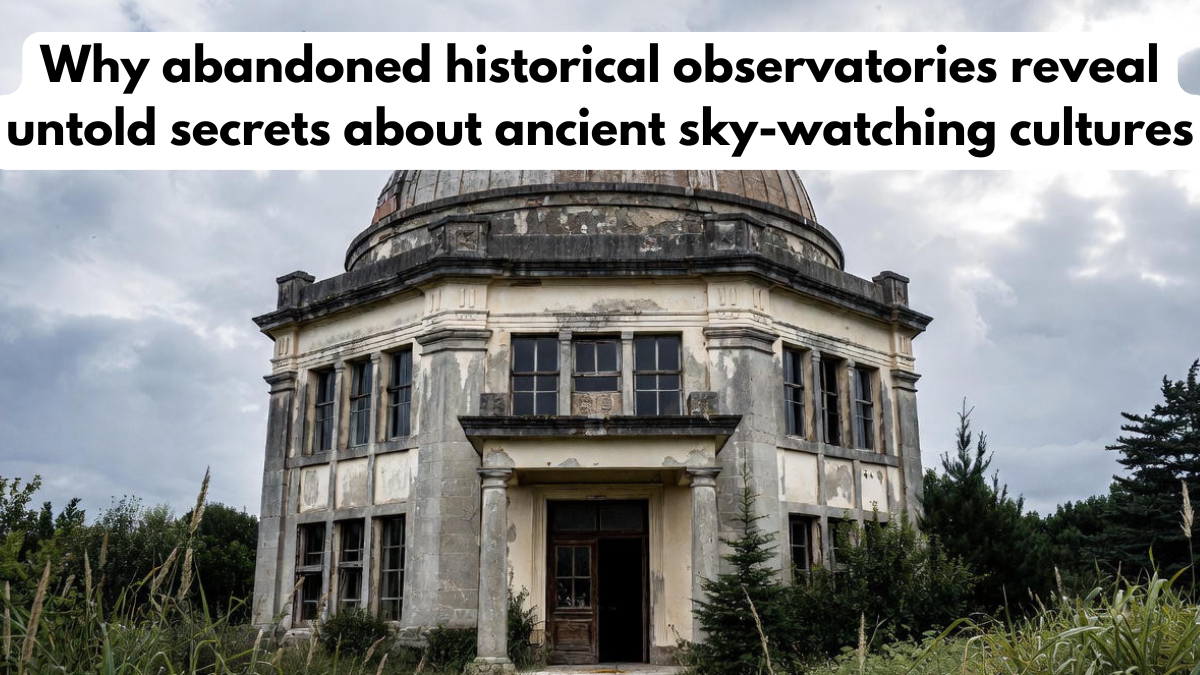
The Purpose and Design of Historical Observatories
Most historical observatories were built with precise alignment to celestial bodies. These structures often tracked the sun’s movement during solstices and equinoxes, allowing ancient people to determine seasonal shifts essential for agriculture. Many observatories included carved stones, shadow markers, or openings designed to capture sunlight or moonlight at specific angles, demonstrating the mathematical and architectural skills of ancient sky-watching cultures.
For example, circular stone arrangements, pyramid-like structures, and elevated platforms served as vantage points for monitoring the sky. These precise designs reveal a sophisticated relationship between architecture and astronomy. Researchers now believe that many of these observatories were used not only for scientific purposes but also for rituals, ceremonies, and cultural traditions. These discoveries highlight how deeply integrated astronomy was within the belief systems of ancient sky-watching cultures, reminding us of humanity’s timeless connection to the heavens.
What Historical Observatories Reveal About Ancient Knowledge Systems
The study of historical observatories has shed light on the remarkable intellectual capabilities of early civilizations. Many observatories were used as calendars, enabling communities to predict planting seasons, harvest cycles, and weather changes. This level of precision indicates that ancient sky-watching cultures possessed a well-developed understanding of astronomy long before modern scientific tools existed.
Additionally, these observatories often point toward specific constellations or solar events that held spiritual or symbolic significance. This suggests that ancient societies viewed the sky as more than a scientific curiosity—they believed celestial patterns influenced their lives, destinies, and religious practices. The careful tracking of planetary movements, lunar cycles, and eclipses further demonstrates the advanced observational skills that defined ancient sky-watching cultures. The more researchers uncover, the clearer it becomes that early civilizations had a rich, interconnected system of astronomical knowledge.
Table: Key Discoveries from Historical Observatories
| Discovery Type | What It Reveals | Link to Ancient Sky-Watching Cultures |
|---|---|---|
| Solar Alignments | Seasonal tracking and timekeeping | Used for agriculture and rituals |
| Lunar Markers | Prediction of lunar cycles | Guided festivals, navigation, and ceremonies |
| Constellation Carvings | Symbolic sky mapping | Connected cosmology with cultural beliefs |
| Architectural Precision | Advanced engineering | Demonstrates scientific intelligence |
| Celestial Event Records | Observations of eclipses and comets | Documented rare events for historical significance |
This table highlights how the study of historical observatories opens the door to understanding the intellectual and cultural achievements of ancient sky-watching cultures.
Cultural and Spiritual Importance of Sky-Watching Traditions
Beyond their scientific role, historical observatories held deep cultural and spiritual significance. Many ancient societies believed that gods, ancestors, or cosmic forces inhabited the sky. As a result, observing celestial movements became an essential part of religious ceremonies, storytelling, and community gatherings. These observatories served as sacred spaces where people connected with the universe, seeking meaning and guidance.
The traditions of ancient sky-watching cultures often intertwined astronomy with mythology. For example, constellations were interpreted as symbolic figures or legendary heroes. Solar and lunar events marked the timing of festivals, social rituals, and communal celebrations. Studying these practices helps modern scholars appreciate the philosophical depth of early civilizations, reminding us that astronomy was not merely practical but also deeply emotional and spiritual for these societies.
How Abandoned Observatories Continue to Influence Modern Research
Even as time and weather have worn down many historical observatories, their impact on modern research remains profound. Archaeologists, astronomers, historians, and anthropologists work together to decode the original purposes of these structures. By studying the alignment of stones or the placement of ancient markers, researchers discover new details about how ancient sky-watching cultures interpreted the sky.
These investigations also inspire modern technological innovation. Some contemporary instruments and observatory designs take inspiration from ancient methods of sky tracking. Furthermore, exploring these historical sites encourages renewed respect for the intellectual achievements of ancient civilizations, challenging misconceptions that early societies lacked scientific sophistication. Through ongoing research, the abandoned observatories of the past continue to shape the astronomical knowledge of the future.
Conclusion
The secrets uncovered within historical observatories tell a powerful story about humanity’s long-standing connection to the cosmos. These ancient structures remind us that early civilizations were far more advanced in astronomy, architecture, and cultural understanding than once believed. By studying the practices of ancient sky-watching cultures, we gain insight into how early societies made sense of the universe and incorporated celestial knowledge into their daily lives.
As researchers continue to explore these extraordinary observatories, they reveal new layers of history, knowledge, and cultural significance. Ultimately, these discoveries deepen our appreciation for humanity’s shared past and inspire curiosity about the mysteries that still remain hidden within the stars.
FAQs
Why were historical observatories important to ancient cultures?
They helped ancient communities track celestial movements for agriculture, rituals, navigation, and cultural traditions.
What can we learn from ancient sky-watching cultures?
We learn that ancient societies had advanced astronomical knowledge and spiritual beliefs connected to the stars.
How precise were ancient observatories?
Many were extremely precise, aligned with solar, lunar, and stellar events with remarkable accuracy.
Are historical observatories still studied today?
Yes, researchers continue examining them to uncover more information about ancient science, architecture, and cultural practices.
Click here to know more.