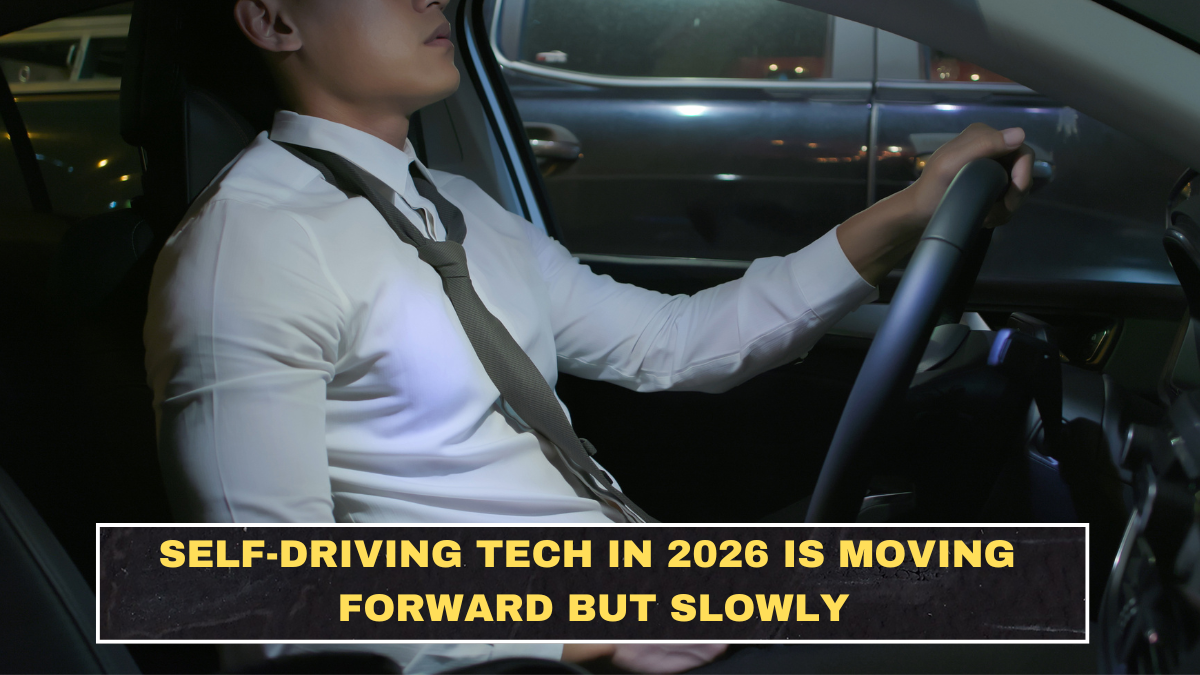
Self-driving tech in 2026 is not dead, but it is not “basically solved” either. The real progress is happening in narrow, controlled use cases, while the fantasy of fully autonomous personal cars for everyone is still lagging. That is why the smartest way to understand this market is to separate robotaxi deployments, Level 3 highway systems, and ordinary driver-assistance features. People keep mixing those together, and that confusion is exactly why the topic gets oversold.
Waymo is the clearest example of actual deployment progress. The company said in 2025 it was already providing more than 200,000 fully autonomous paid trips each week, later raised that to 250,000+ weekly trips, and it has outlined 2026 expansion plans including Washington, D.C., Miami, and Dallas. That is real commercial scale, but it is still a geofenced service model, not a proof that your next family sedan will drive itself anywhere you want.
What is actually improving in self-driving tech in 2026?
The strongest progress is in robotaxis and limited-condition automated driving. Waymo says its driver has logged over 100 million real-world autonomous miles, with newer company materials pointing to nearly 200 million fully autonomous miles, while Reuters reported that it was already delivering hundreds of thousands of paid rides weekly. That matters because scale, repetition, and restricted operating areas are where autonomous systems improve fastest.
A separate track is Level 3 “eyes-off” driving under specific conditions. Mercedes-Benz remains the most concrete example here. Its DRIVE PILOT system has U.S. certification in Nevada and California, and the company says it is the first automaker to certify an SAE Level 3 system for the U.S. market. Reuters also noted in February 2026 that some automakers are pushing toward more eyes-off capability, though these systems remain constrained by speed, road type, and legal conditions.
Why is progress still slower than the hype?
Because full autonomy is brutally hard outside limited environments. Reuters reported that Stellantis shelved Level 3 efforts, citing cost, technical difficulty, and unclear consumer demand. That tells you something important: if big automakers are backing off or narrowing scope, the problem is not just PR timing. The business model and safety burden are still heavy.
Regulators are also forcing more scrutiny. NHTSA requires certain manufacturers and operators to report crashes involving automated driving systems or Level 2 ADAS, and its March 2026 report to Congress says the agency’s recent work remains focused on Levels 3 to 5 systems. That means regulators are not treating this as a solved consumer product category. They are still in oversight, research, and rulemaking mode.
What should consumers stop assuming?
They should stop assuming that “hands-free” means “self-driving.” Tesla’s Full Self-Driving branding still gets mixed into this conversation, but Reuters explicitly reported in February 2026 that Tesla had not introduced an eyes-off Level 3 offering for personal vehicles and still requires the driver to pay attention. That is a huge distinction, because Level 2 driver assistance is not the same thing as a car legally and technically taking over the dynamic driving task.
Consumers should also stop assuming that one company’s success transfers automatically to all others. Waymo’s geofenced robotaxi model is very different from selling consumer-owned self-driving cars nationwide. One is a tightly managed fleet in mapped service areas. The other is a mass-market product expected to handle unpredictable roads, weather, driver behavior, and maintenance variation. Those are not remotely equal challenges.
| Segment | What it does in 2026 | Best example | Main limit |
|---|---|---|---|
| Robotaxi service | Fully autonomous rides in restricted areas | Waymo One | Geofenced, city-by-city expansion |
| Level 3 personal car system | Eyes-off driving in certain highway conditions | Mercedes DRIVE PILOT | Limited roads, speeds, and jurisdictions |
| Level 2 driver assistance | Assists with steering/speed but driver stays responsible | Common across many brands | Not true self-driving |
Where is the real opportunity now?
The real near-term opportunity is not universal autonomy. It is limited autonomy that reduces fatigue, improves safety performance in controlled environments, and scales through fleets first. Waymo’s service expansion shows that commercial ride-hailing can grow where the operating domain is tightly managed. Meanwhile, Mercedes shows that premium highway automation can exist, but only under narrow conditions. That is progress, just not the science-fiction version people were promised.
Conclusion?
Self-driving tech in 2026 is moving forward, but slowly and unevenly. Robotaxis are the clearest sign of real-world progress, while Level 3 personal driving systems remain limited and expensive. The biggest mistake consumers can make is treating all automation claims as the same. They are not. Some systems are genuinely autonomous in specific places. Others are still driver-assistance tools wearing oversized marketing language.
FAQs
Is self-driving technology widely available to consumers in 2026?
No. The most mature deployments are still robotaxi services in specific cities, while personal-car automation remains limited to narrow use cases such as Mercedes’ Level 3 system in approved jurisdictions.
Is Tesla fully self-driving in 2026?
Not in the eyes-off Level 3 sense for consumer vehicles. Reuters reported in February 2026 that Tesla had not introduced a Level 3 offering for personal cars and still requires driver attention.
Who is leading in real-world autonomous rides?
Waymo is the clearest leader in U.S. commercial robotaxi deployment, with 250,000+ paid trips weekly and multiple 2026 city expansion plans.
Why is self-driving progress taking so long?
Because safety, regulation, cost, and edge-case driving complexity are still hard problems. Automakers and regulators are both treating automation as a constrained rollout, not a finished mass-market breakthrough.