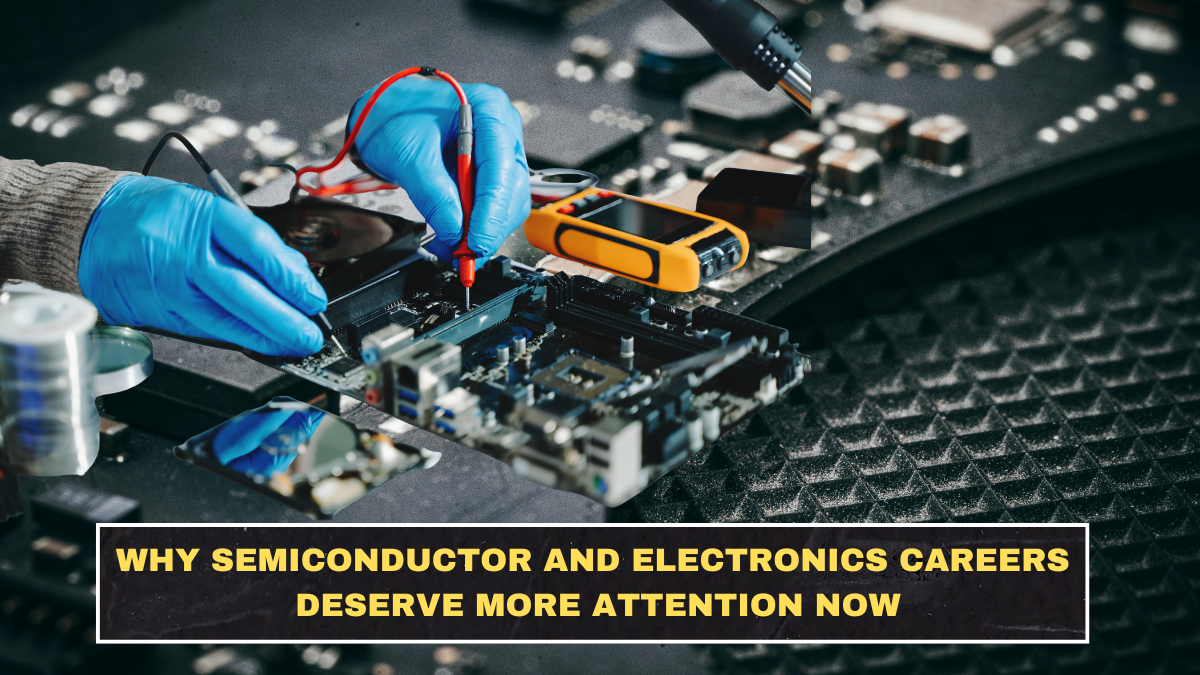
A lot of students still treat semiconductor and electronics careers like niche technical options with limited scope. That is outdated thinking. Hardware, components, embedded systems, electronics manufacturing, testing, and chip-related infrastructure are getting more attention because supply chains, AI hardware demand, telecom, EVs, and industrial systems all depend on them. India’s electronics manufacturing output reached about $125 billion in FY2025, and the government is targeting $500 billion by 2031. Electronics also became India’s third-largest and fastest-growing export category in 2024–25.
The semiconductor side is also moving from talk toward real industrial policy. India’s semiconductor market is projected to reach about $103.4 billion by 2030, and the Union Budget 2026–27 launched India Semiconductor Mission 2.0 while increasing the Electronics Components Manufacturing Scheme outlay to ₹40,000 crore. That is a serious signal that electronics and chip-related work is no longer a side conversation.
What students usually get wrong
The first mistake is assuming these careers are only for elite chip designers. Wrong. The sector needs people across chip design, electronics testing, component manufacturing, embedded systems, equipment maintenance, process control, materials, packaging, and quality roles. The second mistake is chasing hype without understanding the base skills. Semiconductor and electronics work usually rewards fundamentals: circuits, devices, testing, production discipline, materials understanding, and system thinking.
The third mistake is confusing policy announcements with instant easy jobs. That is lazy reasoning. The opportunity is real, but the stronger paths still require technical depth and patience.
Best careers in semiconductor and electronics
| Career path | Why it matters now | Better route into it |
|---|---|---|
| Chip design / VLSI | India already has a strong chip-design talent base | ECE, EEE, VLSI specialization |
| Embedded systems engineer | Devices, automotive, telecom, and industrial systems need embedded logic | ECE, embedded systems, microcontrollers |
| Electronics test engineer | Hardware quality and validation matter in production | ECE, instrumentation, testing tools |
| PCB and component manufacturing roles | India is pushing domestic component capacity | Diploma/ECE/manufacturing pathways |
| Semiconductor packaging and assembly | Packaging is one of India’s early practical chip opportunities | Electronics, manufacturing, quality roles |
| Equipment / maintenance technician | Plants need uptime, calibration, and process discipline | Diploma, industrial electronics, maintenance |
| Process and quality engineer | Manufacturing scale depends on consistency and defect control | ECE, production, quality systems |
| Industrial electronics / power electronics roles | EVs, telecom, consumer hardware, and automation rely on this | EEE, electronics, power systems |
Why this sector looks more serious now
India approved 29 new electronics component-manufacturing projects worth about ₹71.04 billion in March 2026, spanning mobile devices, telecom, consumer electronics, automotive, and hardware components. Earlier approvals in late 2025 were also tied to PCBs, camera modules, laminates, and more than 5,100 direct jobs. That tells you the opportunity is not only in abstract “future tech.” It is in real factories, real components, and real supply chains.
Semiconductor policy is moving too. A Reuters report from May 2025 said India approved the HCL-Foxconn joint venture semiconductor unit, the sixth facility cleared under India Semiconductor Mission, with commercial production targeted for 2027. Budget 2026–27 then added ISM 2.0 with a focus on equipment, materials, Indian IP, and training centres for a future-ready workforce.
The smartest entry paths for students
For most students, electronics and semiconductor careers make the most sense through strong base routes, not fantasy shortcuts.
- Diploma or degree in Electronics and Communication
- Electrical and Electronics Engineering
- Instrumentation or industrial electronics
- Embedded systems, VLSI, PCB design, testing, or manufacturing add-ons
- Quality, maintenance, and process-control skills for factory-side roles
This is the blunt truth: many students would be better off becoming very good at electronics fundamentals than chasing flashy AI titles with weak grounding. Hardware still matters because AI, EVs, telecom, and industrial systems all run on physical components and devices, not just code.
What students should be careful about
Do not assume every “semiconductor course” is strong. If the institute has weak labs, no equipment exposure, no chip-design tools, and no manufacturing relevance, it is probably selling branding. Also, do not romanticize only chip-design roles. India’s near-term opportunities are also in components, packaging, materials, testing, and electronics manufacturing capacity.
Conclusion
Semiconductor and electronics careers deserve more attention now because the industry is moving from broad aspiration to actual capacity-building. India’s electronics output and exports are rising, the semiconductor market is projected to expand sharply by 2030, and new manufacturing and mission-level investments are creating stronger career logic across design, testing, manufacturing, packaging, and embedded systems.
The real mistake is not ignoring these careers because they are boring. The real mistake is ignoring them because they are not trendy enough on social media.
FAQs
Is semiconductor a good career in India now?
Yes, but mainly for students willing to build serious technical skill. India’s semiconductor market and electronics manufacturing push both suggest stronger long-term relevance.
Which branch is best for semiconductor careers?
Electronics and Communication is usually the clearest route, followed by Electrical and Electronics, instrumentation, and specialized VLSI or embedded-systems pathways.
Are electronics manufacturing jobs also worth considering?
Yes. Component manufacturing, testing, PCB work, quality, packaging, and maintenance may be more practical entry routes than many students expect.
Is chip design the only high-value career here?
No. Chip design matters, but packaging, testing, embedded systems, materials, equipment, and process roles are also important parts of the ecosystem.