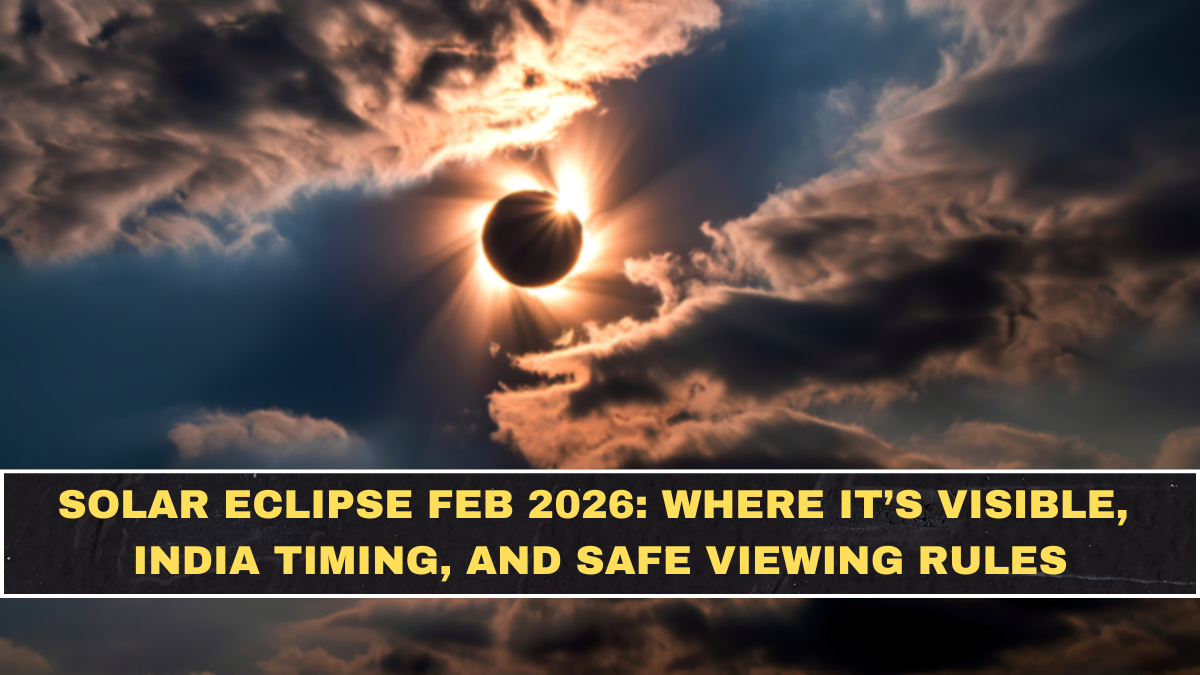
The solar eclipse Feb 2026 is one of the most discussed astronomical events of the year, with millions of people searching for visibility details, timing, and safe viewing methods. A solar eclipse occurs when the Moon moves between the Earth and the Sun, blocking sunlight either partially or completely depending on location. The February 2026 event is particularly interesting because it appears as an annular eclipse in certain regions, creating what is commonly called the “ring of fire” effect in the sky.
Public curiosity around the solar eclipse Feb 2026 is high because visibility differs significantly by region. While some locations experience a clear annular view, others see only a partial eclipse or no eclipse at all. For viewers in India, the event is primarily a skywatching update rather than a visible celestial phenomenon. Understanding where the eclipse is visible, how timing works, and how to watch safely helps avoid confusion and misinformation.
What Type of Solar Eclipse Happens in Feb 2026
The solar eclipse Feb 2026 is an annular solar eclipse. This happens when the Moon is positioned slightly farther from Earth in its orbit, so it does not completely cover the Sun’s surface. Instead of total darkness, a bright ring of sunlight remains visible around the Moon, creating the well-known “ring of fire” appearance.
Unlike a total solar eclipse, an annular eclipse does not cause full daytime darkness. The sky remains partially bright even at peak coverage, though lighting conditions change noticeably. Temperature drops and shadow patterns may shift briefly in regions where the eclipse is visible.
This type of eclipse is scientifically important because it helps researchers study solar radiation and atmospheric effects while allowing observers to experience a rare celestial alignment.
Solar Eclipse Feb 2026 Visibility Around the World
The solar eclipse Feb 2026 is not visible everywhere on Earth. The annular path, where the “ring of fire” effect appears, passes mainly through parts of the Southern Hemisphere. Regions including parts of Antarctica, southern South America, and nearby oceanic areas fall within the main viewing path.
Several regions in Africa and surrounding areas experience a partial solar eclipse, where only a portion of the Sun appears covered. The degree of coverage depends on geographic position relative to the eclipse path.
India does not fall within the visible zone for the solar eclipse Feb 2026. Observers in India will not be able to see the eclipse directly from the sky. However, many people follow the event through live astronomy broadcasts and global observatory streams.
Solar Eclipse Feb 2026 India Timing Explained
Although the solar eclipse Feb 2026 is not visible in India, the event still occurs according to global timing. The eclipse progresses through multiple phases, including the beginning of partial coverage, peak alignment, and completion.
For Indian viewers tracking the event online, the eclipse occurs during evening hours according to Indian Standard Time. Exact timing varies slightly depending on the global phase being observed and the region broadcasting live coverage.
Understanding the timing helps skywatchers follow live feeds from locations where the eclipse is visible. Many astronomy platforms provide real-time tracking visuals showing how the Moon moves across the Sun during the event.
Why Solar Eclipse Visibility Differs by Location
Solar eclipses are highly location-dependent because the Moon’s shadow covers only a limited portion of Earth at any given time. The alignment between the Sun, Moon, and Earth determines which regions experience total, annular, partial, or no visibility.
The solar eclipse Feb 2026 follows a narrow path where the annular phase is visible, while surrounding areas experience reduced coverage. This is why different countries report different viewing experiences for the same astronomical event.
The curvature of Earth and orbital mechanics also affect visibility. Even small changes in geographic position can significantly alter how much of the Sun appears covered.
Safe Viewing Rules for Solar Eclipse Observation
Viewing any solar eclipse requires proper eye protection because direct sunlight can permanently damage vision. Looking at the Sun without certified protection is unsafe even during partial or annular coverage.
Safe viewing methods include:
-
Using certified solar viewing glasses designed for eclipse observation
-
Watching through solar filters attached to telescopes or binoculars
-
Viewing indirect projections such as pinhole projection methods
-
Following official live streams from observatories
Regular sunglasses, camera lenses, or improvised filters do not provide adequate protection. Safe viewing practices remain essential regardless of eclipse type.
How People in India Can Watch the Solar Eclipse Feb 2026
Even though the solar eclipse Feb 2026 is not visible from India, skywatchers can still experience the event through global observation platforms. Many space agencies, research institutions, and astronomy communities broadcast live telescope views from locations along the eclipse path.
These live broadcasts typically show different phases of the eclipse along with expert commentary explaining the phenomenon. This allows viewers to understand the event scientifically without direct sky visibility.
For many people, watching a high-quality live feed offers clearer views than direct observation, especially for events occurring outside their region.
Scientific Importance of Solar Eclipses
Solar eclipses provide valuable opportunities for studying the Sun’s outer atmosphere, solar radiation, and Earth’s atmospheric response. Changes in light levels, temperature variation, and shadow behavior help researchers collect data about environmental and space conditions.
Events like the solar eclipse Feb 2026 also play a role in public science awareness. They encourage interest in astronomy and help people understand planetary motion and celestial alignment.
Although not visible everywhere, each solar eclipse contributes to scientific knowledge and global observation records.
Conclusion: Why the Solar Eclipse Feb 2026 Matters
The solar eclipse Feb 2026 highlights how celestial events connect people worldwide, even when visibility varies by region. While India does not experience direct viewing of this eclipse, the event remains significant for scientific observation and global skywatching.
Understanding eclipse types, timing, visibility zones, and safety practices helps people appreciate the phenomenon accurately. As interest in astronomy continues to grow in 2026, events like the solar eclipse Feb 2026 serve as reminders of Earth’s position within a dynamic solar system.
Following the event responsibly, whether through direct observation or live coverage, allows people to experience one of nature’s most remarkable alignments safely and meaningfully.
FAQs
Is the solar eclipse Feb 2026 visible in India?
No, the solar eclipse Feb 2026 is not visible from India. The main annular path passes through regions in the Southern Hemisphere.
What type of eclipse is the February 2026 event?
It is an annular solar eclipse, where the Moon does not completely cover the Sun, creating a bright ring of sunlight.
What is the “ring of fire” in a solar eclipse?
The “ring of fire” occurs when the Moon appears smaller than the Sun and leaves a glowing ring of sunlight around its edge.
Is it safe to view a solar eclipse directly?
No, direct viewing without certified solar glasses or proper filters can damage eyesight. Safe viewing methods must always be used.
How can people in India watch the solar eclipse Feb 2026?
Viewers in India can watch live telescope broadcasts and real-time streams from regions where the eclipse is visible.
Why do solar eclipses not occur everywhere at once?
The Moon’s shadow covers only a limited area of Earth, so visibility depends on geographic location and alignment.