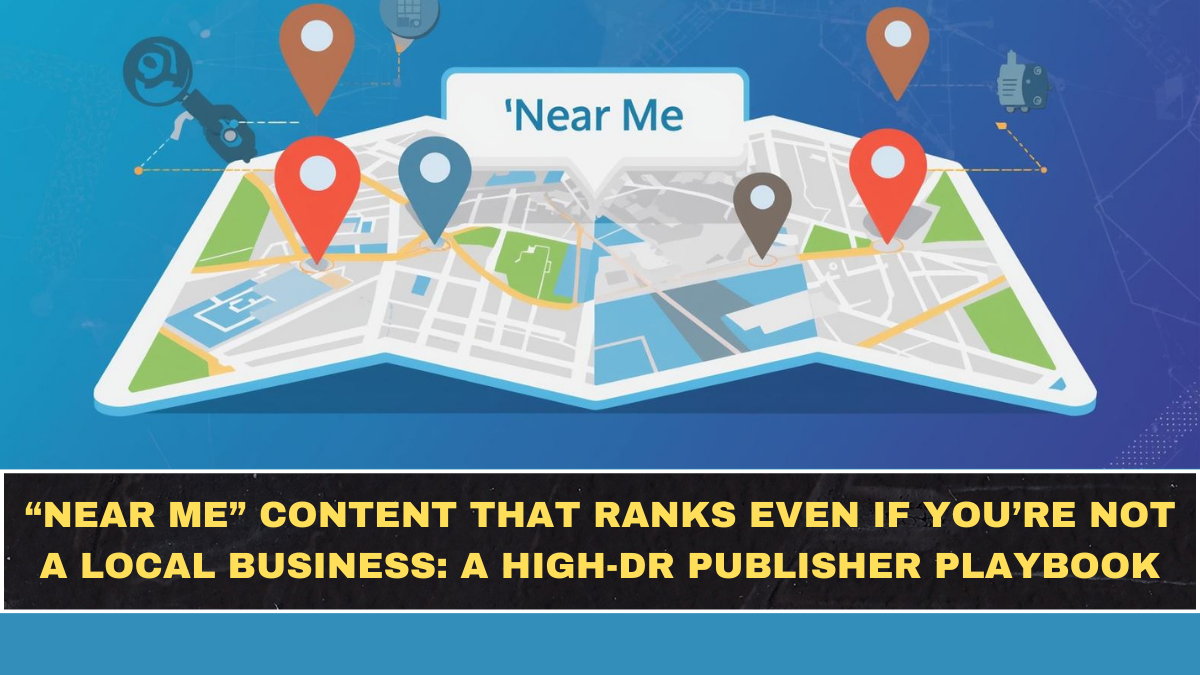
“Near me” searches look simple on the surface, but they reveal one of the strongest intent signals in modern search behavior. When users type “near me,” they are not browsing. They are acting. This is why these queries convert well and why Google treats them with special seriousness. In 2026, however, ranking for “near me” is no longer limited to shops, clinics, or restaurants with addresses.
High-DR publishers are ranking for “near me” queries without being local businesses at all. They do it by understanding intent layers, not by pretending to be local. This article explains exactly how that works, what types of “near me” content succeed, and how publishers can capture this traffic ethically and consistently.
Why “Near Me” Searches Are Still Exploding in 2026
Mobile-first behavior has normalized “near me” as shorthand for urgency. Users want fast answers tied to location relevance, not necessarily a storefront.
Search patterns show “near me” appended to services, safety queries, rules, emergencies, utilities, and information needs. These are not transactional in the traditional sense.
Google rewards clarity and usefulness more than physical proximity in many of these cases.
The Biggest Misunderstanding About “Near Me” SEO
Many sites assume “near me” means maps, pins, and addresses. That is only true for discovery searches like cafes or salons.
For informational and utility searches, “near me” actually means “relevant to where I am.” This opens the door for publishers who explain processes, rules, or next steps that apply locally.
Understanding this distinction is the foundation of ranking without a location.
Types of “Near Me” Queries That Non-Local Sites Can Rank For
Certain categories consistently favor informational content. These include government services, safety help, digital issues, compliance steps, and emergency guidance.
Queries like “police station near me,” “court near me,” or “bank branch near me” often surface explainer pages alongside maps. Google wants users to understand what to do next.
Publishers that guide users through actions win visibility.
How Google Interprets Location Intent
Google already knows the user’s approximate location. It does not need your site to repeat city names aggressively.
What it needs is confirmation that your content adapts to different locations logically. This can be done through neutral phrasing, process explanations, and conditional language.
Local relevance is inferred, not declared.
The Content Formats That Work Best
List-style guides perform strongly. Step-by-step explainers also rank well because they reduce friction.
For example, instead of claiming “best office near you,” publishers explain how to find the correct office based on district, service type, or urgency.
Google favors content that shortens decision paths.
Why Utility Beats Authority in “Near Me” Queries
High authority alone does not guarantee ranking. Utility does.
Pages that answer “what now,” “where exactly,” and “how fast” outperform pages filled with generic information. This is especially true on mobile.
Near me queries reward clarity under pressure.
How to Structure “Near Me” Content Correctly
Content should open by acknowledging urgency without dramatizing it. Then it should explain how the system works locally in general terms.
Instead of listing locations, explain how locations are determined. This keeps the content evergreen and scalable.
The structure should reduce confusion, not impress algorithms.
Why Over-Localization Hurts Rankings
Stuffing city names or pretending to be everywhere reduces trust. Google penalizes false local signals.
High-DR publishers succeed by staying neutral and adaptable. They let Google match the user’s location, not the content.
Honesty improves ranking stability.
Internal Linking Makes “Near Me” Pages Stronger
Near me pages perform better when linked from related utility content. This builds topical authority.
For example, linking from safety guides, rule explainers, or emergency checklists strengthens relevance signals.
Contextual relevance matters more than anchor text tricks.
What Most Publishers Get Wrong
They chase “near me” keywords directly instead of understanding the intent behind them.
They either avoid these queries entirely or misuse them aggressively. Both approaches fail.
The winning approach is intent translation, not keyword imitation.
How This Strategy Fits High-DR Content Sites
High-DR sites already have trust. What they often lack is urgency-oriented utility content.
Adding “near me” compatible guides expands reach without competing with local businesses unfairly.
This strategy scales across categories, not just one niche.
Conclusion: “Near Me” Is About Help, Not Location
In 2026, “near me” searches are about immediacy, clarity, and reassurance. They are not always about maps.
Publishers that understand this shift can rank consistently without pretending to be local. The goal is to guide users through decisions, not hijack local intent.
When content reduces stress and speeds up action, Google notices.
FAQs
Can a non-local site rank for “near me” queries?
Yes, especially for informational and utility-based searches.
Do I need to add city names to rank?
No, Google uses user location automatically.
Are “near me” queries only for businesses?
No, many are informational and process-driven.
What type of content works best for these queries?
Step-by-step guides and decision-support content.
Is this strategy safe for long-term SEO?
Yes, if content is honest and intent-aligned.
Do “near me” pages need frequent updates?
Only if the underlying rules or processes change.