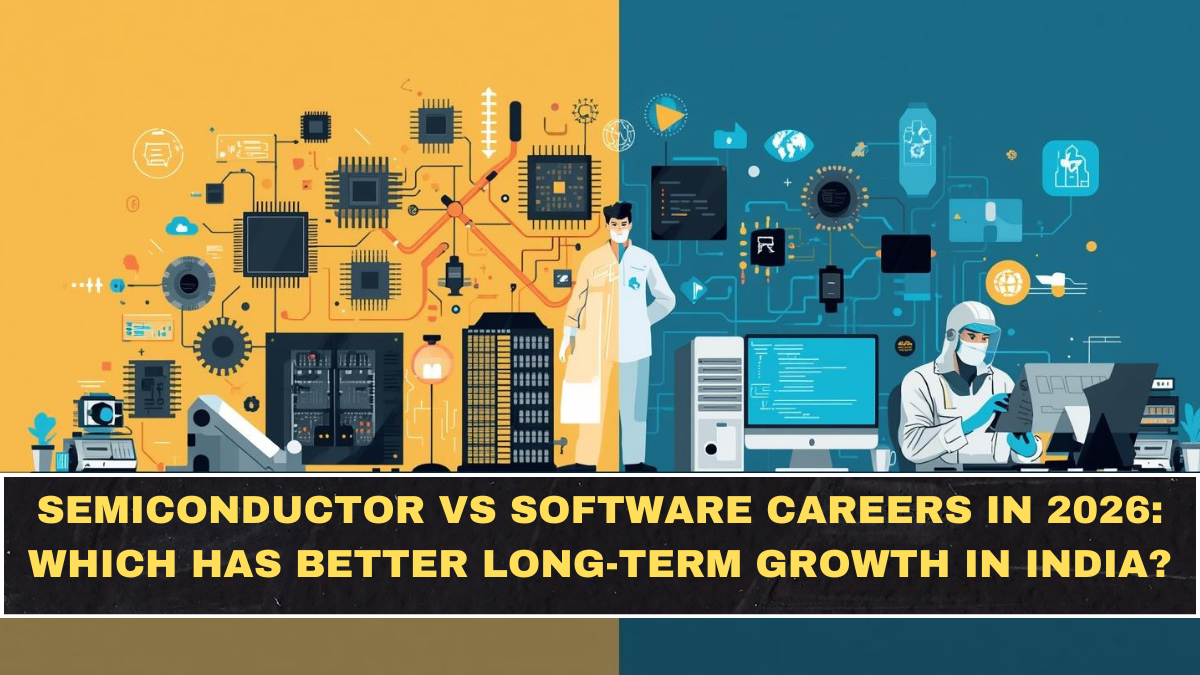
Choosing between a semiconductor career and a software career in 2026 is no longer a simple question of “core versus IT.” Both paths have matured, and both now demand very different kinds of commitment, patience, and thinking. The real decision is not about which field is more prestigious, but about which one aligns better with how you want to grow, learn, and earn over the next decade.
In India, this choice has become sharper because government focus, global supply chains, AI adoption, and hiring corrections have reshaped both ecosystems. Software careers are no longer guaranteed fast growth, while semiconductor roles are no longer niche or inaccessible. Understanding the real trade-offs helps avoid decisions based on outdated advice.
How Software Careers Look in India in 2026
Software careers in 2026 are broader but more competitive. Entry is easier, but differentiation is harder.
Most graduates can learn basic software skills, which has increased supply at the entry level. As a result, generic roles see slower salary growth unless paired with specialization.
Growth now depends on depth in areas like cloud, AI systems, security, or platform engineering rather than general coding ability.
How Semiconductor Careers Look in India in 2026
Semiconductor careers remain technically demanding and slower to enter, but they offer clearer long-term positioning.
Roles in VLSI design, verification, physical design, and validation require strong fundamentals and longer learning cycles. Entry barriers are higher, which limits supply.
In 2026, India’s expanding chip ecosystem has made these roles more visible and structurally important.
Entry Difficulty and Learning Curve Comparison
Software careers have a gentler entry curve. A motivated learner can become employable relatively quickly.
Semiconductor careers require deeper academic grounding, especially in electronics and hardware concepts. Learning takes longer and mistakes are costlier.
This difference filters candidates early, which affects competition and long-term saturation.
Salary Growth Reality Over Time
Software salaries often grow faster in the early years, especially for those who switch roles strategically. However, growth can plateau if skills become common.
Semiconductor salaries grow more steadily. Early compensation may be modest, but specialization increases value over time.
In India, experienced semiconductor professionals often enjoy strong bargaining power due to limited supply.
Job Stability and Industry Cycles
Software roles are more sensitive to hiring cycles and budget cuts. Demand fluctuates with global tech sentiment.
Semiconductor roles are tied to longer investment cycles. Projects span years, not quarters, which provides relative stability.
In 2026, professionals seeking predictability often prefer hardware-oriented roles.
Skill Longevity and Obsolescence
Software tools and frameworks change rapidly. Continuous learning is mandatory to stay relevant.
Semiconductor fundamentals age slowly. Core concepts remain valid across decades, even as tools evolve.
This makes semiconductor careers more stable for those who value deep expertise over constant reinvention.
Work Nature and Daily Life Differences
Software work often involves rapid iteration, cross-functional collaboration, and changing requirements. Ambiguity is common.
Semiconductor work is structured, detail-oriented, and precise. Errors are expensive and reviews are rigorous.
Choosing between them often comes down to temperament as much as opportunity.
Global Mobility and Opportunities
Software skills transfer easily across industries and countries. Global mobility is relatively high.
Semiconductor roles also offer global opportunities, but mobility depends on specialization and company presence.
In 2026, both paths offer international exposure, but software remains more flexible geographically.
Risk Profile and Career Resilience
Software careers carry higher short-term opportunity but higher volatility. Market corrections affect hiring quickly.
Semiconductor careers carry higher entry risk but stronger long-term resilience once established.
In India’s evolving economy, resilience matters as much as speed.
Who Should Choose Software Careers
Software suits those who enjoy fast learning cycles, experimentation, and frequent change. It rewards adaptability and communication.
Candidates who like building systems, products, or platforms with visible impact often thrive here.
In 2026, success requires continuous upskilling and strategic specialization.
Who Should Choose Semiconductor Careers
Semiconductors suit those who enjoy deep technical work, patience, and precision. The field rewards consistency and mastery.
Candidates comfortable with long learning curves and delayed gratification perform best.
In India, ECE graduates with strong fundamentals find this path increasingly viable and respected.
Common Myths That Mislead Career Decisions
One myth is that software always pays more. This is no longer universally true.
Another myth is that semiconductors are too hard or limited. In reality, the ecosystem is expanding steadily.
In 2026, informed decisions beat popular advice.
Conclusion: Long-Term Growth Depends on Fit, Not Hype
The choice between semiconductor and software careers in 2026 is not about right or wrong, but about alignment. Software offers speed, flexibility, and variety but demands constant reinvention. Semiconductors offer depth, stability, and long-term value but require patience and strong fundamentals.
In India’s changing tech landscape, both paths can lead to strong careers if chosen consciously. Those who chase trends without understanding themselves often struggle. Those who align skills, temperament, and long-term goals with the right ecosystem build careers that last.
FAQs
Which career pays more in India in 2026, semiconductor or software?
Early software roles may pay more, but senior semiconductor roles often match or exceed them.
Is it too late to enter semiconductors in 2026?
No. Entry is harder, but demand for skilled professionals is growing steadily.
Are software jobs less stable now?
They are more sensitive to market cycles, but stability improves with specialization.
Can ECE students switch to software easily?
Yes, but long-term differentiation may be harder without specialization.
Which career has better long-term growth?
Semiconductors offer steadier long-term growth, while software offers faster early momentum.
What matters more than salary when choosing?
Learning style, risk tolerance, and patience matter more than short-term pay.