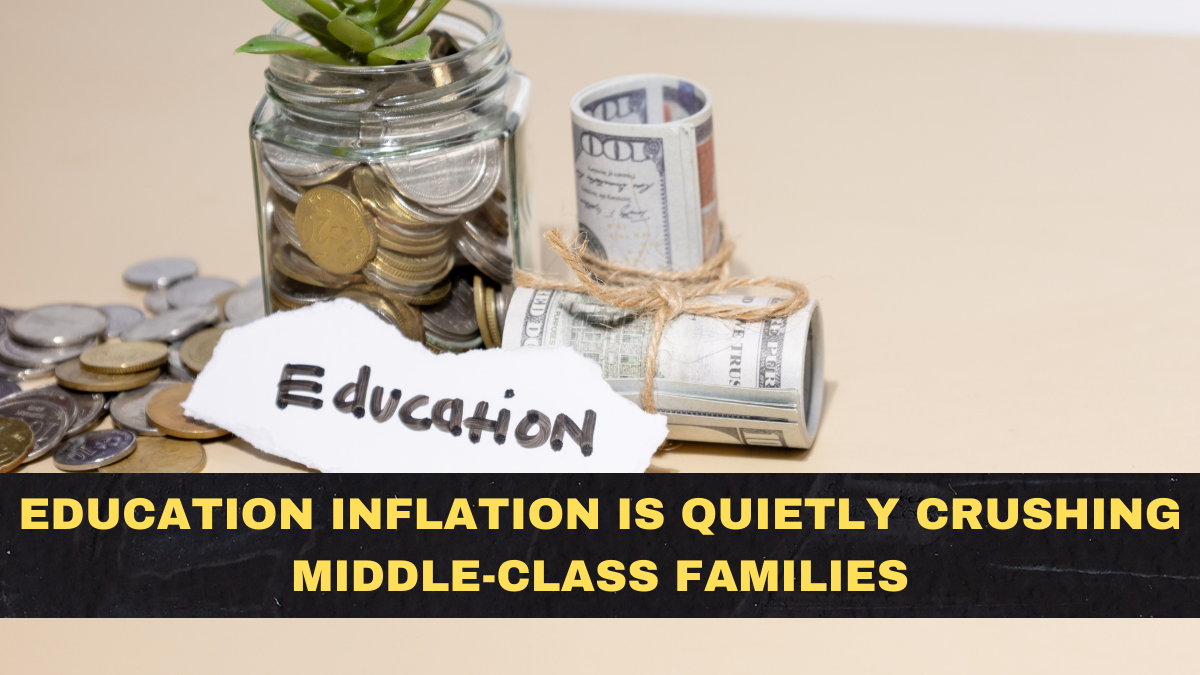
Education in India has always been seen as the safest investment for upward mobility. In 2026, however, that belief is being severely tested as education inflation continues to rise faster than household incomes. For middle-class families, the cost of educating a child now feels less like an investment and more like a long-term financial strain that never fully recovers.
What makes education inflation particularly dangerous is how quietly it operates. Fees increase gradually, hidden costs pile up silently, and families adjust by cutting savings or taking loans without fully realizing the cumulative impact. By the time the degree is complete, financial stress has already become a permanent part of family life.
What Education Inflation Really Means in 2026
Education inflation refers to the rate at which education-related costs rise compared to general income growth. Tuition fees, coaching costs, accommodation, and learning tools all contribute.
In 2026, these costs have outpaced salary growth for most middle-class households. Even modest institutions demand budgets that were once associated with premium education.
Affordability has become a moving target.
Why College Fees Keep Rising Every Year
Institutions justify fee hikes using infrastructure upgrades, technology adoption, and operational expenses.
However, fee increases often exceed actual improvements in learning outcomes. Competition among colleges fuels pricing rather than quality.
In 2026, fees reflect market positioning more than educational value.
The Explosion of Coaching and Supplementary Costs
Tuition fees are only part of the story. Coaching classes, test preparation, and private tutoring have become almost mandatory.
Parents spend heavily to keep children competitive. These costs are rarely disclosed upfront.
Education inflation accelerates outside the classroom.
Hidden Costs Parents Rarely Calculate
Accommodation, transport, devices, software subscriptions, and project expenses add up quickly.
These recurring costs stretch budgets over several years. Families underestimate their long-term impact.
By graduation, total spending far exceeds initial expectations.
How Education Inflation Forces Families Into Debt
Savings alone are no longer sufficient for higher education. Loans fill the gap.
Middle-class families borrow aggressively, assuming future salaries will compensate. This assumption often fails.
In 2026, debt has become a standard part of education financing.
Why Scholarships and Aid Are Not Enough
Scholarships exist, but availability is limited and competition intense.
Most aid covers only a fraction of total costs. Many families fall into the gap where they earn too much to qualify but too little to afford fees.
This leaves the middle class most exposed.
The Emotional Cost of Rising Education Expenses
Financial pressure affects family dynamics. Parents feel constant anxiety about affordability.
Students carry guilt, knowing the sacrifices being made for their education. Stress replaces focus.
Education inflation has emotional consequences, not just financial ones.
Why Education Inflation Affects Career Choices
Students choose courses based on perceived salary potential rather than interest.
Riskier but fulfilling paths are avoided due to repayment pressure. Careers become financially driven from the start.
In 2026, education costs shape life decisions more than aptitude.
The Long-Term Impact on Wealth Building
High education spending reduces savings and investment capacity.
Families delay home purchases, retirement planning, and emergency funds.
Education inflation quietly erodes long-term financial security.
Why This Problem Keeps Getting Ignored
Education cost increases happen gradually, avoiding public backlash.
Each family absorbs the burden individually. Collective concern rarely builds.
This silence allows education inflation to continue unchecked.
What Families Can Do to Reduce Education Cost Pressure
Early planning matters. Comparing outcomes, not prestige, helps control costs.
Exploring diverse education pathways reduces dependence on expensive options. Financial realism is essential.
In 2026, informed choices are the strongest defense.
Conclusion: Education Is Becoming Less Affordable, Not More Accessible
Education inflation in India is reshaping the middle class quietly but profoundly.
Rising costs without proportional income growth create long-term stress that degrees do not always justify.
Unless affordability becomes a serious priority, education risks becoming a financial burden rather than a ladder to opportunity.
FAQs
What is education inflation in simple terms?
It is the rapid rise in education-related costs compared to income growth.
Why are education costs rising so fast in India?
Due to fee hikes, coaching dependence, infrastructure spending, and market-driven pricing.
Are education loans the only solution now?
They are common, but they increase long-term financial pressure.
Why does education inflation affect the middle class the most?
Because they earn too much for aid but not enough to absorb rising costs comfortably.
Do higher fees guarantee better education?
No, higher fees do not always translate into better outcomes.
How can families plan better against education inflation?
By focusing on outcome-based choices, early financial planning, and realistic budgeting.